Showing posts with label Paul Krugman. Show all posts

Friday, September 26, 2014

Targeting Two

In the Washington Post, Jared Bernstein asks why the Fed's inflation target is 2 percent. "The fact is that the target is 2 percent because the target is 2 percent," he writes. Bernstein refers to a paper by Laurence Ball suggesting that a 4% target could be preferable by reducing the likelihood of the economy running up against the zero lower bound on nominal interest rates.

Paul Krugman chimes in, adding that a 2 percent target:
"was low enough that the price stability types could be persuaded, or were willing to concede as a possibility, that true inflation — taking account of quality changes — was really zero. Meanwhile, as of the mid 1990s modeling efforts suggested that 2 percent was enough to make sustained periods at the zero lower bound unlikely and to lubricate the labor market sufficiently that downward wage stickiness would have minor effects. So 2 percent it was, and this rough guess acquired force as a focal point, a respectable place that wouldn’t get you in trouble. 
The problem is that we now know that both the zero lower bound and wage stickiness are much bigger issues than anyone realized in the 1990s."
Krugman calls the target "the terrible two," and laments that "Unfortunately, it’s now very hard to change the target; anything above 2 isn’t considered respectable."

Dean Baker also has a post in which he explains that Krugman's discussion of the 2 percent target "argues that it is a pretty much arbitrary compromise between the idea that the target should be zero (the dollar keeps its value constant forever) and the idea that we need some inflation to keep the economy operating smoothly and avoid the zero lower bound for interest rates. This is far too generous... Not only is there not much justification for 2.0 percent, there is not much justification for any target."

I'll add three papers, in reverse chronological order, that should be relevant to this discussion. Yuriy Gorodnichenko, Olivier Coibion, and Johannes Wieland have a 2010 paper called, "The Optimal Inflation Rate in New Keynesian Models: Should Central Banks Raise their Inflation Targets in Light of the ZLB?" They say the answer is probably no:
The optimal inflation rate implied by the model is 1.2% per year which is within, but near the bottom, of the range of implicit inflation targets used by central banks in industrialized countries of 1-3% per year. In addition, the welfare loss from higher inflation rates is non-trivial: raising the target rate from 1.2% to 4% per year is equivalent to permanently reducing consumption by nearly 2%. In short, using a calibrated model of the U.S. economy which balances the costs of inflation arising from infrequent adjustment of prices against the benefit of reducing the frequency of hitting the ZLB yields an optimal inflation target which is certainly no higher than what is currently in use by central banks.
Their model balances the costs of inflation that arise from infrequent price adjustment against the benefit of reducing the frequency of hitting the zero lower bound. In the model, at 0 percent inflation, the zero lower bound would be binding 15 percent of the time, while at 3.5 percent  inflation, the bound would bind 4 percent of the time, but the costs from price stickiness would be high. They compute that welfare would be maximized at 1.2 percent inflation.

Another paper, which I would guess influenced some people at the Fed, is by George Akerlof, William Dickens, and George Perry in 2000. They build a model in which some agents in the economy are "near rational" instead of fully rational in the way they think about inflation:
"when inflation is low it is not especially salient, and wage and price setting will respond less than proportionally to expected inflation. At sufficiently high rates of inflation, by contrast, anticipating inflation becomes important and wage and price setting responds fully to expected inflation."
As a result, there is some moderate positive level of inflation that is optimal for employment. They estimate that this optimal rate of inflation is between 1.6 and 3.2 percent.

The first few sections of the Akerlof et al. paper are interesting in that they discuss how psychologists and economists have different approaches to the way they think about people's decisionmaking. The model in the paper tries to take a more realistic, but still relatively simple, approach to how people make decisions based on their inflation expectations. I wouldn't be surprised if this paper influenced the adoption of the 2% target.

And then, of course, is John Taylor's 1993 paper, "Discretion versus Policy Rules in Practice." Just about everyone at the Fed must have read it at some point. Here's his original Taylor rule from page 202:

If GDP is at target, the rule suggests raising the federal funds rate if inflation is above 2 percent and lowering it if inflation is less than 2 percent. He calls 2 percent the Fed's implicit target. Later he writes that "Given biases...in measuring prices, the 2-percent per year implicit inflation target rate is probably very close to price stability or zero inflation" (p. 210). This is probably where Krugman gets his argument that 2 percent "was low enough that the price stability types could be persuaded, or were willing to concede as a possibility, that true inflation — taking account of quality changes — was really zero." More importantly, this paper probably helped propagate the idea that the Fed has had an implicit 2 percent inflation target since at least the early 1990s. So when deciding on an explicit target in 2012, 2 percent seemed a natural choice.

Thursday, June 12, 2014

Cab Drivers, Preachers, and Economists' Wives

Lately I have been working on a Great Depression-era economic history paper to constitute one chapter of my dissertation. The practice of writing a history paper is highly enjoyable. It can send you deep into the (thankfully in my case mostly digital) archives. For younger scholars, it is one of the best ways to learn about and reflect on your chosen profession. This can sometimes be quite humorous.

Irving Fisher was a Yale professor and one of the best-known economists of the early 20th century. His weekly Business Page, the closest thing to an economics blog of the time, was widely syndicated in newspapers across the country. His modern day counterpart greatly praises his debt deflation theory, and deservedly so. In addition to good insights, Fisher had many good lines.

The best came at a meeting of the American Academy of Political and Social Sciences in November 1933. Picture Fisher at the podium about to make the closing remarks for the meeting. He begins,
"It is more than fair of the presiding officer to give me not only the first word, but the last word."
(One of the other speakers was a United States Senator, by the way.) Maybe it doesn't take an economist to think this way, but it takes one to speak this way. This is just some relatively benign self-aggrandizement, and a good ego is always good for a good laugh. Another quote, from the 1971 Journal of Money, Credit, and Banking, also made me laugh, but seemed less benign.
"Who among us [economists] has not listened politely to the bizarre theories of the Great Depression as proffered by cab drivers, preachers, and (worst of all) economists' wives? One simply learns to avoid cabs, churches, and home each time the Grapes of Wrath makes one of the film festivals or books by Studs Terkel about Huey P. Long make the best-seller lists."
Fisher only asserts his superiority to other economists and politicians, whereas this economist asserts economists' intellectual superiority to the public at large, or at least its female and service professional components. "Isn't it cute when our wives try to understand the economy? Aren't we great for being so polite to the poor dolts?"

Now, the vast majority of economists I know today have the utmost respect for their spouses' intellects. What we should avoid at all costs is a "polite" disregard of the intellect of the general public. Economists shouldn't "avoid cabs, churches, and home." Cabs, churches and home are the economy. (And I can think of one particular preacher whose vision of economics will not be ignored.) Economic policy would function more smoothly if more people understood it. In a democracy, people deserve the chance to understand the economy and economic policies that affect their lives. This is put really well by Alan Blinder and coauthors (2009), regarding monetary policy:
"It may be time to pay some attention to communication with the general public...In the end, it is the general public that gives central banks their democratic legitimacy, and hence their independence."
This is also why I really respect efforts like those of Annamaria Lusardi to teach economic and financial literacy to the public under the assumption that everyone is capable of understanding, so long as they are given the opportunity to learn.

Monday, October 28, 2013

Abenomics and Japanese Inflation Expectations

Paul Krugman has an "extremely wonky" new post about how to measure inflation expectations in Japan under Abenomics. The measure uses Treasury Inflation Protected Securities (TIPS), the topic of a series I am writing on this blog and the Noahpinion blog. Inflation-protected securities may be used to infer breakeven inflation expectations from the market. Japan's market in inflation-protected securities is considered too thin to provide useful information about expectations, so Krugman, building on the approach of Benjamin Mandel and Geoffrey Barnes, combines US TIPS data and real exchange rate data to measure Japanese inflation expectations:
I took the implied 10-year breakeven inflation rate from US TIPS, minus the 10-year interest rate differential, plus the real appreciation Japan would experience if the real exchange rate against the dollar 10 years from now were to return to its level in January 2010. You can adjust this as you like with whatever your estimate of the difference between the 1-2010 rate and the equilibrium rate is; it will just shift the line up or down.
The result is inflation expectations just below 0 until the start of 2012. Expectations rise to almost 3% by May 2013, then fall to around 1.5% by July 2013. Krugman writes:
I have my doubts about the apparent decline in recent months. It’s being driven not by events in Japan but by the taper scare, which drove up US rates. There is a question about why that rise in US rates didn’t produce a lot more yen depreciation, but something seems off here. 
The main point, however, is that this measure does suggest a substantial rise in expected inflation since Abenomics began, which is good news.
Another indicator of inflation expectations is the Bank of Japan's Opinion Survey on the General Public's Views and Behavior. According to this survey, there is no evidence of a decline in inflation expectations in recent months. The most recent survey, from June 2013, shows a continued rise in one-year-ahead expectations from December to March to June. The June average expectation was 5.1% and the median expectation was 3%. In 2010, the median expectation was 0% and the mean around 2%. Longer-term inflation expectations (which should correspond more closely to Krugman's measure) are also rising, though more gradually.

Source: Bank of Japan Opinion Survey
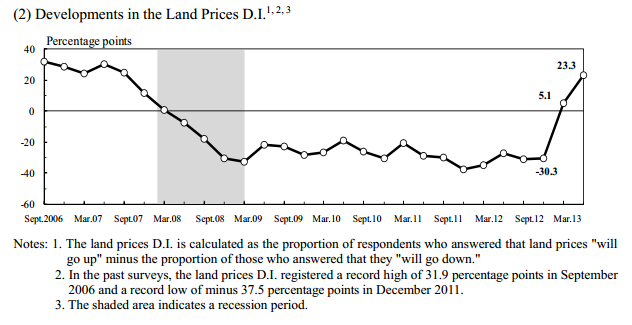
Also at a new high is the survey's measure of land price expectations. This is a newer development; the sharp rise began in late 2012:
Even if the expectations reported by surveyed households are not an accurate indicator of what will actually happen with inflation, they are still relevant. In the United States, households in the Michigan Survey of Consumers report higher inflation expectations than professional forecasts or TIPS-based measures. A new paper by Yuriy Gorodnichenko and Olivier Coibion, summarized by Jim Hamilton, suggests that the household expectations are important in explaining the "missing deflation" of the past few years.

Neither Krugman's US TIPS-based measure nor the household survey-based measure are perfect indicators of Japanese inflation expectations. But the fact that both indicate a rise in expectations since Abenomics began, combined with the dramatic increase in the index of land price expectations, convinces me at least qualitatively that expectations are rising, though I'd put huge error bars on any quantitative estimate. 

Krugman calls the rise in inflation expectations "good news." I agree, with a qualification. In an earlier post, "What Does Abenomics Feel Like?", I noted that Japanese consumers viewed rising prices extremely unfavorably. This, unsurprisingly, has not changed. There are, after all, no significant changes in perceptions of employment and working conditions.  In the mind of a typical consumer, more concerned with her own purchasing power than with liquidity trap economics, rising prices are not such a signifier of salvation. 

But there is a glimmer of hope. Consumers' perceptions of current economic conditions and of the economy's growth potential are both looking-- well, not bright, but brighter than before.


Monday, August 12, 2013

Heisenberg's Uncertainty Index

The title of Matt O'Brien's recent post--"Uncertainty Isn't Killing the Recovery"-- summarizes a slurry of recent articles. O'Brien writes, "as Jim Tankersley of the Washington Post points out, uncertainty has actually fallen a lot the past few months, but hiring hasn't picked up." Tankersley's title proclaims a similar message: "'Uncertainty' Isn't a Problem Anymore."

The boldest title of all (no surprise) comes from Paul Krugman: "Another Bad Story Bites The Dust."

I thought about following the Very Descriptive Titles trend and calling my post "Whoa, Whoa, Wait a Minute Guys," or "Let's Not Throw Out the Baby with the Bathwater Just Yet" or "Uncertainty Might Matter So Maybe We Should Let Smart People Keep Studying It If They Want." (But I was too much of a nerd to resist the title I actually chose, which I will eventually explain.) Legitimate criticism of political discourse is one thing. But we shouldn't, in the meanwhile, dismiss a large, promising, and growing area of research.

The recent articles find fault with the Economic Policy Uncertainty index of Scott Baker and Nick Bloom of Stanford and Stephen Davis of the University of Chicago. The index is based in part on how often major newspapers talk about phrases related to economic policy uncertainty. The basic idea of the criticism has to do with uncertainty a la Heisenberg. The non-technical version of the Heisenberg Uncertainty Principle is that, in observing something, we change it. The usual context is quantum mechanics, but it applies in other contexts too. In this context, the idea is that once the Economic Policy Uncertainty index was publicized, conservative politicians and pundits found it a useful talking point, and by talking and writing about it so much, they actually drove the index higher. So what the economists were observing--the frequency of mentions of uncertainty-related phrases-- was actually altered by the attempt to observe it.

This is a valid, but not devastating point. First, we don't know how large this "Heisenberg effect" is. Conservative punditry could have had only a small effect on the index. Second, it is not that hard to think of ways to improve the index to minimize this problem. Simplest idea: exclude articles that include the exact phrase "economic policy uncertainty index" or the words Baker, Bloom, Davis, Stanford, or Chicago. Slightly less simple idea: Aren't there really sophisticated quantitative text analysis tools available these days that could measure the amount of uncertainty in the tone of economics/business articles? Third, and most important, is that there is much more to Baker, Bloom, and Davis' research than the index itself. Bloom's 2007 paper, "The Impact of Uncertainty Shocks"--written before the construction of the index-- helped kick off a surge of macroeconomic uncertainty research. Many of Baker, Bloom, and Davis' contributions, and those of authors they have motivated, have been theoretical. A slightly flawed measure beats no measure at all if it encourages researchers to pay attention to an important subject. And I would venture to guess that the vast majority of these researchers are not motivated by a political agenda. They are motivated by the desire to understand something they think might really matter.

For what it's worth, I think the Economic Policy Uncertainty index does have decent construct validity. The creators of the index make an analogous index for Europe. In an unpublished working paper, I make a totally different uncertainty index for Europe, based on the how uncertain professional forecasters are in their probabilistic forecasts for GDP growth 2-years ahead. (I chose Europe instead of the US because of data availability.) My uncertainty measure is plotted along with the Economic Policy Uncertainty index below; the correlation coefficient is 0.8. The fact that they are created by totally different methodologies, from totally different data sources, and yet are this highly correlated, makes me think that there is at least some measurement validity.


I appreciate John Aziz's more moderately-titled post, "On Policy Uncertainty," in which he writes:
Krugman is right to... trash those who view the sluggishness of the recovery as solely Obama’s fault. But he’s wrong, I think, to throw policy uncertainty out of the window entirely as a proximate cause of some of the problem’s we’re now facing.

Thursday, March 7, 2013

Krugman and Plosser on Deleveraging

On March 6, 2013, Philadelphia Fed President Charles Plosser argued that low interest rates are actually causing people to save more, not less, because the income effect currently outweighs the substitution effect. In his words:
The conventional view is that by lowering interest rates, monetary accommodation tends to encourage households to reduce savings and thus consume more today. However, as I’ve noted, in the current circumstances, consumers have strong incentives to save. They are deleveraging and trying to restore the health of their balance sheets so they will be able to retire or put their children through college. They are behaving wisely and in a perfectly rational and prudent way in the face of the reduction in wealth.

In fact, low interest rates and fiscal stimulus spending that leads to larger government budget deficits may be designed to stimulate aggregate demand or consumption, but they could actually do the opposite. For example, low interest rates encourage households to save even more because the return on their savings is very small. And large budget deficits suggest to households that they are likely to face higher taxes in the future, which also encourages more saving. In my view, until household balance sheets are restored to a level that consumers and households are comfortable with, consumption will remain sluggish. Attempts to increase economic “stimulus” may not help speed up the process and may actually prolong it.
This reminds me of an article by Paul Krugman last year called Deleveraging Shocks and the Multiplier (Sort of Wonkish).
So, the simple but surely broadly correct story of the mess we’re in is that we had a period of excessive complacency about leverage, which came to a sudden end. Household debt in particular surged, then was suddenly perceived as excessive...
Leveraging up, other things equal, leads to high aggregate demand — but this can be and is in practice offset by the central bank, which can always raise rates. Deleveraging, on the other hand, can’t be offset equally easily; the central bank can cut rates, but only to zero, and unconventional monetary policy is both controversial and an iffy proposition (which doesn’t mean that it shouldn’t be tried).
So far, Plosser and Krugman more or less agree. Households are deleveraging because they really want to deleverage, we're at the zero lower bound, and unconventional monetary policy is iffy. (As Plosser puts it, "We are operating in an uncertain environment and using nontraditional policies with which we have limited experience.")

Here's where the big, big difference comes in. Plosser also said that fiscal stimulus wouldn't work in this scenario because "large budget deficits suggest to households that they are likely to face higher taxes in the future, which also encourages more saving." Let's break this down.

An increase in the deficit raises both current income and expected future taxes. If the government spending multiplier is one, an increase in the deficit is neutral for consumption. So people consume the same amount they otherwise would have, and save the additional income to use to pay future taxes.Yes, large deficits encourage more saving, but without reducing consumption. In other words, they increase the total level of savings people have, but they decrease the rate of saving out of current income. The rate versus level distinction is important. If households follow some heuristic about a minimum theshold level of saving they want to achieve (e.g. make sure to have $5,000 saved in case of emergency), then they could reach that threshold quicker (and stop deleveraging) through fiscal stimulus. And that is just assuming the multiplier is one. Even better if it is larger...which of course brings us back to Krugman:

Now, the same thing that makes deleveraging so hard to handle also makes the fiscal multiplier larger than it is in normal times. Normally, expansionary fiscal policy is offset by monetary tightening, contractionary policy by monetary loosening. Hence the lowish multiplier estimates based on recent history. But if deleveraging has pushed you into a liquidity trap, there are no offsets...Start by provisionally assuming a frictionless world in which consumers have perfect foresight and perfect access to capital markets. In that case the multiplier should be exactly 1...A rise in government spending does mean higher expected future taxes — but it also means higher incomes right now, and those two effects should exactly cancel each other.
Now add in realistic frictions, notably households that are liquidity-constrained and/or use rules of thumb based on current income to make spending decisions. (By the way, as Gauti Eggertsson and I have pointed out, once you’re using a debt/deleveraging model you are already in effect assuming that many households face liquidity constraints). These frictions will mean that a rise or fall in current income due to fiscal policy will lead to at least some movement of consumption in the same direction. So we get a multiplier bigger than 1.
But I would add that this is not just a question of whether the multiplier is bigger than one. Whether or not the multiplier is bigger than one, in fact just as long as it is bigger than zero, fiscal policy will at least help people reach their level-of-savings targets quicker, if that is the way some people decide how much to save (which seems intuitively reasonable.) Unfortunately, as Meryl Motika pointed out in her post yesterday, we don't know enough yet about how people decide to save. And that's getting to be a highly pressing issue for both monetary and fiscal policy.

Sunday, December 23, 2012

Inflation Targeting Pressure in Japan

I recently wrote an article for the forthcoming Global Economic History Encyclopedia about inflation targeting. I only submitted the article for editing a few days ago, but it looks like it may be due for updates before the encyclopedia even comes out! The reason is news that Shinzo Abe, future premier of Japan, is pressuring the Bank of Japan (BOJ) to adopt a 2% inflation target. Apparently, if the bank refuses, Abe will try to change the law guaranteeing BOJ independence. Currently, the BOJ has a 1% inflation target. This is pretty big news, but I haven't seen any economist's analysis in the press yet, so I'll try to walk through some of the basic implications.

The Japanese economy experienced deflation and economic stagnation in the 1990s, recovered somewhat from 2003 to 2007, then fell back into recession. Consumer prices have fallen 6.8% since 1997. Richard Koo's book calls the extended Japanese recession "The Holy Grail of Macroeconomics" because of the light it can shed on macroeconomic theory. Paul Krugman has also repeatedly looked to Japan to study the macroeconomy under conditions of recession, deflation, and the liquidity trap.

To analyze the news about the possible 2% target, something to keep in mind is the relationship between interest rates and inflation. The nominal interest rate is the real interest rate plus expected inflation. There is a zero lower bound (ZLB) on nominal interest rates, since potential lenders would rather just hold cash than lend at negative nominal interest rates. Real interest rates affect decisions about spending and investing now versus later, so they affect aggregate demand. Typically in a recession, monetary authorities want to lower interest rates to boost aggregate demand. A certain level of real interest rates would theoretically restore full employment. But, especially when inflation is low or negative, the ZLB on nominal interest rates can prevent the real interest rate from going sufficiently low. This situation is called a liquidity trap, and renders conventional monetary policy obsolete.

Since the real interest rate is the nominal rate minus expected inflation, raising expected inflation can help lower the real interest rate. But raising expectations about future inflation is not a straightforward task. If a central bank starts printing a lot of money, the public still might not believe that it would continue to do so in the future, when the bank's incentives would be different. One purported solution is for the bank to publicly and explicitly commit to an inflation target. The public commitment is intended to add credibility, so that expectations will actually change.

The other relevant relationship is between exchange rates and inflation. If inflation in Japan is expected to be higher, then the yen will have less purchasing power in the future, so the yen will depreciate. Depreciation of the yen makes Japanese exports relatively cheaper and imports relatively more expensive. So a higher inflation target could reduce Japan's trade deficit, which has been large this year.

My final comment is that central bank independence is not a goal in and of itself. It may be a means of arriving at the goal of effective monetary policy, or it may not. Typically, central bank independence does facilitate effective monetary policy by adding credibility. But at the moment, the BOJ is not credible enough to achieve its 1% inflation target. Maybe if the 2% target were instituted by another part of the government considered more credible, it would actually be more effective. In conclusion, I am somewhat hopeful that Japan is headed in a good direction. Either the BOJ will adopt a 2% target, which will be seen as more credible due to government support, or the government will itself impose the target, which would be drastic enough to cause the markets to notice, bringing about some aggregate demand stimulus.

_______________________________________________________
P.S. I haven't written in awhile for two exciting reasons. First, I have been working on articles for the Global Economic History Encyclopedia. Along with inflation targeting, I have written about the euro area, the Basel Accords, the National Monetary Commission, the gold standard, the Glass-Steagall Act, Wildcat Banking, the Credit Anstalt Crisis, and a few others.

Second, I haven't been writing because I was too busy getting married and going on a honeymoon! I married Joe Binder on December 1 at Christ the King Catholic Church in Dallas, TX. Then we drove across the Southwest for our honeymoon, stopping at a lot of national parks and monuments including Carlsbad Caverns, Guadalupe Mountain, White Sands, Tucson, Sedona, the Gila Cliff Dwellings, and the Grand Canyon. We feel so happy and blessed and are excited about our first Christmas together!