Showing posts with label Federal Reserve. Show all posts

Wednesday, July 18, 2018

From Senior Thesis to Publication

One of the most challenging and rewarding aspects of my job at Haverford College is advising senior theses. At Haverford, every student in every major writes a senior thesis (or equivalent capstone project). I co-teach the senior thesis course in the fall with two or three colleagues, and advise thesis writers in the spring. In the fall, students work on choosing a topic and research question, conducting a literature review, and developing a research proposal. In the spring, they work one-on-one with an advisor to see the proposal through.

Every completed thesis is an achievement, and we celebrate all of our seniors with a champagne reception on the due date. But today, for the first time, one of my advisee's theses has successfully made its way through the peer review process and is published!

Samantha Wetzel, Haverford College class of 2018, excelled both as an economics student and on the basketball team. We published "The FOMC versus the staff, revisited: When do policymakers add value?" in Economics Letters. (This link should provide temporary free access to the published version; here is the SSRN working paper version.)

The thesis, and this letter based on it, follow up on Romer and Romer's (2008) similarly-titled paper. Here is the abstract:
The Board of Governors staff and the Federal Open Market Committee both publish macroeconomic forecasts. Romer and Romer (2008) show that policymakers' attempts to add information to the staff forecasts are counterproductive. In more recent years, however, policymakers have improved upon staff forecasts. We show that policymakers' value-added is greater when economic conditions are unfavorable or uncertain.
For other undergraduate researchers hoping to write a successful, potentially publishable thesis, I have a few bits of advice based on this advising experience. First, start early if possible. Samantha came up with her thesis topic during junior year, when she read Romer and Romer (2008) in my course on the Federal Reserve.

Second, ask a well-defined question. This may be the hardest part. Your thesis (like Sam's) will probably be much longer than the 2000 word limit of Economics Letters, with a longer literature review and more robustness checks etc., but you should be able to easily explain what you asked, what you found, and how you found it in a few pages. Your thesis is far more likely to be successful if you have a primary hypothesis that you can precisely state. (Even if you think you can state it, write it down to be sure!)

Third, come up with a plan so that you can make progress each week-- use your advisor to help you decide on a timeline for key goals and to hold you accountable. For student athletes like Samantha, this means thinking in advance about when key games and travel will be, and planning accordingly.

Tuesday, October 24, 2017

Is Taylor a Hawk or Not?

Two Bloomberg articles published just a week apart call John Taylor, a contender for Fed Chair, first hawkish, then dovish. The first, by Garfield Clinton Reynolds, notes:
...The dollar rose and the 10-year U.S. Treasury note fell on Monday after Bloomberg News reported Taylor, a professor at Stanford University, impressed President Donald Trump in a recent White House interview. 
Driving those trades was speculation that the 70 year-old Taylor would push rates up to higher levels than a Fed helmed by its current chair, Janet Yellen. That’s because he is the architect of the Taylor Rule, a tool widely used among policy makers as a guide for setting rates since he developed it in the early 1990s.
But the second, by Rich Miller, claims that "Taylor’s Walk on Supply Side May Leave Him More Dove Than Yellen." Miller explains,
"While Taylor believes the [Trump] administration can substantially lift non-inflationary economic growth through deregulation and tax changes, Yellen is more cautious. That suggests that the Republican Taylor would be less prone than the Democrat Yellen to raise interest rates in response to a policy-driven economic pick-up."
What actually makes someone a hawk? Simply favoring rules-based policy is not enough. A central banker could use a variation of the Taylor rule that implies very little response to inflation, or that allows very high average inflation. Beliefs about the efficacy of supply-side policies also do not determine hawk or dove status. Let's look at the Taylor rule from Taylor's 1993 paper:
r = p + .5y + .5(p – 2) + 2,
where r is the federal funds rate, y is the percent deviation of real GDP from target, and p is inflation over the previous 4 quarters. Taylor notes (p. 202) that lagged inflation is used as a proxy for expected inflation, and y=100(Y-Y*)/Y* where Y is real GDP and Y* is trend GDP (a proxy for potential GDP).

The 0.5 coefficients on the y and (p-2) terms reflect how Taylor estimated that the Fed approximately behaved, but in general a Taylor rule could have different coefficients, reflecting the central bank's preferences. The bank could also have an inflation target p* not equal to 2, and replace (p-2) with (p-p*). Just being really committed to following a Taylor rule does not tell you what steady state inflation rate or how much volatility a central banker would allow. For example, a central bank could follow a rule with p*=5 and a relatively large coefficient on y and small coefficient on (p-5), allowing both high and volatile inflation.

What do "supply side" beliefs imply? Well, Miller thinks that Taylor believes the Trump tax and deregulatory policy changes will raise potential GDP, or Y*. For a given value of Y, a higher estimate of Y* implies a lower estimate of y, which implies lower r. So yes, in the very short run, we could see lower r from a central banker who "believes" in supply side economics than from one who doesn't, all else equal.

But what if Y* does not really rise as much as a supply-sider central banker thinks it will? Then the lower r will result in higher p (and Y), to which the central bank will react by raising r. So long as the central bank follows the Taylor principle (so the sum of the coefficients on p and (p-p*) in the rule are greater than 1), equilibrium long-run inflation is p*.

The parameters of the Taylor rule reflect the central bank's preferences. The right-hand-side variables, like Y*, are measured or forecasted. That reflects a central bank's competence at measuring and forecasting, which depends on a number of factors ranging from the strength of its staff economists to the priors of the Fed Chair to the volatility and unpredictability of other economic conditions and policies. 

Neither Taylor nor Yellen seems likely to change the inflation target to something other than 2 (and even if they wanted to, they could not unilaterally make that decision.) They do likely differ in their preferences for stabilizing inflation versus stabilizing output, and in that respect I'd guess Taylor is more hawkish. 

Yellen's efforts to look at alternative measures of labor market conditions in the past are also about Y*. In some versions of the Taylor rule, you see unemployment measures instead of output measures (where the idea is that they generally comove). Willingness to consider multiple measures of employment and/or output is really just an attempt to get a better measure on how far the real economy is from "potential." It doesn't make a person inherently more or less hawkish.

As an aside, this whole discussion presumes that monetary policy itself (or more generally, aggregate demand shifts) do not change Y*. Hysteresis theories reject that premise. 

Friday, October 13, 2017

Rethinking Macroeconomic Policy

I had the pleasure of attending “Rethinking Macroeconomic Policy IV” at the Peterson Institute for International Economics. I highly recommend viewing the panels and materials online.

The two-day conference left me wondering what it actually means to “rethink” macro. The conference title refers to rethinking macroeconomic policy, not macroeconomic research or analysis, but of course these are related. Adam Posen’s opening remarks expressed dissatisfaction with DSGE models, VARs, and the like, and these sentiments were occasionally echoed in the other panels in the context of the potentially large role of nonlinearities in economic dynamics. Then, in the opening session, Olivier Blanchard talked about whether we need a “revolution” or “evolution” in macroeconomic thought. He leans toward the latter, while his coauthor Larry Summers leans toward the former. But what could either of these look like? How could we replace or transform the existing modes of analysis?

I looked back on the materials from Rethinking Macroeconomic Policy of 2010. Many of the policy challenges discussed at that conference are still among the biggest challenges today. For example, low inflation and low nominal interest rates limit the scope of monetary policy in recessions. In 2010, raising the inflation target and strengthening automatic fiscal stabilizers were both suggested as possible policy solutions meriting further research and discussion. Inflation and nominal rates are still very low seven years later, and higher inflation targets and stronger automatic stabilizers are still discussed, but what I don’t see is a serious proposal for change in the way we evaluate these policy proposals.

Plenty of papers use basically standard macro models and simulations to quantify the costs and benefits of raising the inflation target. Should we care? Should we discard them and rely solely on intuition? I’d say: probably yes, and probably no. Will we (academics and think tankers) ever feel confident enough in these results to make a real policy change? Maybe, but then it might not be up to us.

Ben Bernanke raised probably the most specific and novel policy idea of the conference, a monetary policy framework that would resemble a hybrid of inflation targeting and price level targeting. In normal times, the central bank would have a 2% inflation target. At the zero lower bound, the central bank would allow inflation to rise above the 2% target until inflation over the duration of the ZLB episode averaged 2%. He suggested that this framework would have some of the benefits of a higher inflation target and of price level targeting without some of the associated costs. Inflation would average 2%, so distortions from higher inflation associated with a 4% target would be avoided. The possibly adverse credibility costs of switching to a higher target would also be minimized. The policy would provide the usual benefits of history-dependence associated with price level targeting, without the problems that this poses when there are oil shocks.

It’s an exciting idea, and intuitively really appealing to me. But how should the Fed ever decide whether or not to implement it? Bernanke mentioned that economists at the Board are working on simulations of this policy. I would guess that these simulations involve many of the assumptions and linearizations that rethinking types love to demonize. So again: Should we care? Should we rely solely on intuition and verbal reasoning? What else is there?

Later, Jason Furman presented a paper titled, “Should policymakers care whether inequality is helpful or harmful for growth?” He discussed some examples of evaluating tradeoffs between output and distribution in toy models of tax reform. He begins with the Mankiw and Weinzierl (2006) example of a 10 percent reduction in labor taxes paid for by a lump-sum tax. In a Ramsey model with a representative agent, this policy change would raise output by 1 percent. Replacing the representative agent with agents with the actual 2010 distribution of U.S. incomes, only 46 percent of households would see their after-tax income increase and 41 percent would see their welfare increase. More generally, he claims that “the growth effects of tax changes are about an order of magnitude smaller than the distributional effects of tax changes—and the disparity between the welfare and distribution effects is even larger” (14). He concludes:
“a welfarist analyzing tax policies that entail tradeoffs between efficiency and equity would not be far off in just looking at static distribution tables and ignoring any dynamic effects altogether. This is true for just about any social welfare function that places a greater weight on absolute gains for households at the bottom than at the top. Under such an approach policymaking could still be done under a lexicographic process—so two tax plans with the same distribution would be evaluated on the basis of whichever had higher growth rates…but in this case growth would be the last consideration, not the first” (16).

As Posen then pointed out, Furman’s paper and his discussants largely ignored the discussions of macroeconomic stabilization and business cycles that dominated the previous sessions on monetary and fiscal policy. The panelists acceded that recessions, and hysteresis in unemployment, can exacerbate economic disparities. But the fact that stabilization policy was so disconnected from the initial discussion of inequality and growth shows just how much rethinking still has not occurred.

In 1987, Robert Lucas calculated that the welfare costs of business cycles are minimal. In some sense, we have “rethought” this finding. We know that it is built on assumptions of a representative agent and no hysteresis, among other things. And given the emphasis in the fiscal and monetary policy sessions on avoiding or minimizing business cycle fluctuations, clearly we believe that the costs of business cycle fluctuations are in fact quite large. I doubt many economists would agree with the statement that “the welfare costs of business cycles are minimal.” Yet, the public finance literature, even as presented at a conference on rethinking macroeconomic policy, still evaluates welfare effects of policy using models that totally omit business cycle fluctuations, because, within those models, such fluctuations hardly matter for welfare. If we believe that the models are “wrong” in their implications for the welfare effects of fluctuations, why are we willing to take their implications for the welfare effects of tax policies at face value?

I don’t have a good alternative—but if there is a Rethinking Macroeconomic Policy V, I hope some will be suggested. The fact that the conference speakers are so distinguished is both an upside and a downside. They have the greatest understanding of our current models and policies, and in many cases were central to developing them. They can rethink, because they have already thought, and moreover, they have large influence and loud platforms. But they are also quite invested in the status quo, for all they might criticize it, in a way that may prevent really radical rethinking (if it is really needed, which I’m not yet convinced of). (A more minor personal downside is that I was asked multiple times whether I was an intern.)

If there is a Rethinking Macroeconomic Policy V, I also hope that there will be a session on teaching and training. The real rethinking is going to come from the next generations of economists. How do we help them learn and benefit from the current state of economic knowledge without being constrained by it? This session could also touch on continuing education for current economists. What kinds of skills should we be trying to develop now? What interdisciplinary overtures should we be making?

Thursday, September 28, 2017

An Inflation Expectations Experiment

Last semester, my senior thesis advisee Alex Rodrigue conducted a survey-based information experiment via Amazon Mechanical Turk. We have coauthored a working paper detailing the experiment and results titled "Household Informedness and Long-Run Inflation Expectations: Experimental Evidence." I presented our research at my department seminar yesterday with the twin babies in tow, and my tweet about the experience is by far my most popular to date:

Consumers' inflation expectations are very disperse; on household surveys, many people report long-run inflation expectations that are far from the Fed's 2% target. Are these people unaware of the target, or do they know it but remain unconvinced of its credibility? In another paper in the Journal of Macroeconomics, I provide some non-experimental evidence that public knowledge of the Fed and its objectives is quite limited. In this paper, we directly treat respondents with information about the target and about past inflation, in randomized order, and see how they revise their reported long-run inflation expectations. We also collect some information about their prior knowledge of the Fed and the target, their self-reported understanding of inflation, and their numeracy and demographic characteristics. About a quarter of respondents knew the Fed's target and two-thirds could identify Yellen as Fed Chair from a list of three options.

As shown in the figure above, before receiving the treatments, very few respondents forecast 2% inflation over the long-run and only about a third even forecast in the 1-3% range. Over half report a multiple-of-5% forecast, which, as I argue in a recent paper in the Journal of Monetary Economics, is a likely sign of high uncertainty. When presented with a graph of the past 15 years of inflation, or with the FOMC statement announcing the 2% target, the average respondent revises their forecast around 2 percentage points closer to the target. Uncertainty also declines.

The results are consistent with imperfect information models because the information treatments are publicly available, yet respondents still revise their expectations after the treatments. Low informedness is part of the reason why expectations are far from the target. The results are also consistent with Bayesian updating, in the sense that high prior uncertainty is associated with larger revisions. But equally noteworthy is the fact that even after receiving both treatments, expectations are still quite heterogeneous and many still substantially depart from the target. So people seem to interpret the information in different ways and view it as imperfectly credible.

We look at how treatment effects vary by respondent characteristic. One interesting result is that, after receiving both treatments, the discrepancy between mean male and female inflation expectations (which has been noted in many studies) nearly disappears (see figure below).

There is more in the paper about how treatment effects vary with other characteristics, including respondents' opinion of government policy and their prior knowledge. We also look at whether expectations can be "un-anchored from below" with the graph treatment.


Monday, August 21, 2017

New Argument for a Higher Inflation Target

On voxeu.org, Philippe Aghion, Antonin Bergeaud, Timo Boppart, Peter Klenow, and Huiyu Li discuss their recent work on the measurement of output and whether measurement bias can account for the measured slowdown in productivity growth. While the work is mostly relevant to discussions of the productivity slowdown and secular stagnation, I was interested in a corollary that ties it to discussions of the optimal level of the inflation target.

The authors note the high frequency of "creative destruction" in the US, which they define as when "products exit the market because they are eclipsed by a better product sold by a new producer." This presents a challenge for statistical offices trying to measure inflation:
The standard procedure in such cases is to assume that the quality-adjusted inflation rate is the same as for other items in the same category that the statistical office can follow over time, i.e. products that are not subject to creative destruction. However, creative destruction implies that the new products enter the market because they have a lower quality-adjusted price. Our study tries to quantify the bias that arises from relying on imputation to measure US productivity growth in cases of creative destruction.
They explain that this can lead to mismeasurement of TFP growth, which they quantify by examining changes in the share of incumbent products over time:
If the statistical office is correct to assume that the quality-adjusted inflation rate is the same for creatively destroyed products as for surviving incumbent products, then the market share of surviving incumbent products should stay constant over time. If instead the market share of these incumbent products shrinks systematically over time, then the surviving subset of products must have higher average inflation than creatively destroyed products. For a given elasticity of substitution between products, the more the market share shrinks for surviving products, the more the missing growth.
From 1983 to 2013, they estimate that "missing growth" averaged about 0.63% per year. This is substantial, but there is no clear time trend (i.e. there is not more missed growth in recent years), so it can't account for the measured productivity growth slowdown.

The authors suggest that the Fed should consider adjusting its inflation target upwards to "get closer to achieving quality-adjusted price stability." A few months ago, 22 economists including Joseph Stiglitz and Narayana Kocherlakota wrote a letter urging the Fed to consider raising its inflation target, in which they stated:
Policymakers must be willing to rigorously assess the costs and benefits of previously-accepted policy parameters in response to economic changes. One of these key parameters that should be rigorously reassessed is the very low inflation targets that have guided monetary policy in recent decades. We believe that the Fed should appoint a diverse and representative blue ribbon commission with expertise, integrity, and transparency to evaluate and expeditiously recommend a path forward on these questions.
The letter did not mention this measurement bias rationale for a higher target, but the blue ribbon commission they propose should take it into consideration.

Friday, August 18, 2017

The Low Misery Dilemma

The other day, Tim Duy tweeted:

It took me a moment--and I'd guess I'm not alone--to even recognize how remarkable this is. The New York Times ran an article with the headline "Fed Officials Confront New Reality: Low Inflation and Low Unemployment." Confront, not embrace, not celebrate.

The misery index is the sum of unemployment and inflation. Arthur Okun proposed it in the 1960s as a crude gauge of the economy, based on the fact that high inflation and high unemployment are both miserable (so high values of the index are bad). The misery index was pretty low in the 60s, in the 6% to 8% range, similar to where it has been since around 2014. Now it is around 6%. Great, right?

The NYT article notes that we are in an opposite situation to the stagflation of the 1970s and early 80s, when both high inflation and high unemployment were concerns. The misery index reached a high of 21% in 1980. (The unemployment data is only available since 1948).

Very high inflation and high unemployment are each individually troubling for the social welfare costs they impose (which are more obvious for unemployment). But observed together, they also troubled economists for seeming to run contrary to the Phillips curve-based models of the time. The tradeoff between inflation and unemployment wasn't what economists and policymakers had believed, and their misunderstanding probably contributed to the misery.

Though economic theory has evolved, the basic Phillips curve tradeoff idea is still an important part of central bankers' models. By models, I mean both the formal quantitative models used by their staffs and the way they think about how the world works. General idea: if the economy is above full employment, that should put upward pressure on wages, which should put upward pressure on prices.

So low unemployment combined with low inflation seem like a nice problem to have, but if they are indeed a new reality-- that is, something that will last--then there is something amiss in that chain of logic. Maybe we are not at full employment, because the natural rate of unemployment is a lot lower than we thought, or we are looking at the wrong labor market indicators. Maybe full employment does not put upward pressure on wages, for some reason, or maybe we are looking at the wrong wage measures. For example, San Francisco Fed researchers argue that wage growth measures should be adjusted in light of retiring Baby Boomers. Or maybe the link between wage and price inflation has weakened.

Until policymakers feel confident that they understand why we are experiencing both low inflation and low unemployment, they can't simply embrace the low misery. It is natural that they will worry that they are missing something, and that the consequences of whatever that is could be disastrous. The question is what to do in the meanwhile.

There are two camps for Fed policy. One camp favors a wait-and-see approach: hold rates steady until we actually observe inflation rising above 2%. Maybe even let it stay above 2% for awhile, to make up for the lengthy period of below-2% inflation. The other camp favors raising rates preemptively, just in case we are missing some sign that inflation is about to spiral out of control. This latter possibility strikes me as unlikely, but I'm admittedly oversimplifying the concerns, and also haven't personally experienced high inflation.


Monday, August 7, 2017

Labor Market Conditions Index Discontinued

A few years ago, I blogged about the Fed's new Labor Market Conditions Index (LMCI). The index attempts to summarize the state of the labor market using a statistical technique that captures the primary common variation from 19 labor market indicators. I was skeptical about the usefulness of the LMCI for a few reasons. And as it turns out, the LMCI is now discontinued as of August 3.

The discontinuation is newsworthy because the LMCI was cited in policy discussions at the Fed, even by Janet Yellen. The index became high-profile enough that I was even interviewed about it on NPR's Marketplace.

One issue that I noted with the index in my blog was the following:
A minor quibble with the index is its inclusion of wages in the list of indicators. This introduces endogeneity that makes it unsuitable for use in Phillips Curve-type estimations of the relationship between labor market conditions and wages or inflation. In other words, we can't attempt to estimate how wages depend on labor market tightness if our measure of labor market tightness already depends on wages by construction.
This corresponds to one reason that is provided for the discontinuation of the index: "including average hourly earnings as an indicator did not provide a meaningful link between labor market conditions and wage growth."

The other reasons provided for discontinuation are that "model estimates turned out to be more sensitive to the detrending procedure than we had expected" and "the measurement of some indicators in recent years has changed in ways that significantly degraded their signal content."

I also noted in my blog post and on NPR that the index is almost perfectly correlated with the unemployment rate, meaning it provides very little additional information about labor market conditions. (Or interpreted differently, meaning that the unemployment rate provides a lot of information about labor market conditions.) The development of the LMCI was part of a worthy effort to develop alternative informative measures of labor market conditions that can help policymakers gauge where we are relative to full employment and predict what is likely to happen to prices and wages. So since resources and attention are limited, I think it is wise that they can be directed toward developing and evaluating other measures. 

Wednesday, May 31, 2017

Low Inflation at "Essentially Full Employment"

Yesterday, Brad Delong took issue with Charles Evans' recent claim that "Today, we have essentially returned to full employment in the U.S." Evans, President of the Federal Reserve Bank of Chicago and a member of the FOMC, was speaking before the Bank of Japan Institute for Monetary and Economic Studies in Tokyo on "lessons learned and challenges ahead" in monetary policy. Delong points out that the age 25-54 employment-to-population ratio in the United States of 78.5% is low by historical standards and given social and demographic trends.

Evans' claim that the U.S. has returned to full employment is followed by his comment that "Unfortunately, low inflation has been more stubborn, being slower to return to our objective. From 2009 to the present, core PCE inflation, which strips out the volatile food and energy components, has underrun 2% and often by substantial amounts." Delong asks,
And why the puzzlement at the failure of core inflation to rise to 2%? That is a puzzle only if you assume that you know with certainty that the unemployment rate is the right variable to put on the right hand side of the Phillips Curve. If you say that the right variable is equal to some combination with weight λ on prime-age employment-to-population and weight 1-λ on the unemployment rate, then there is no puzzle—there is simply information about what the current value of λ is.
It is not totally obvious why prime-age employment-to-population should drive inflation distinctly from unemployment--that is, why Delong's λ should not be zero, as in the standard Phillips Curve. Note that the employment-to-population ratio grows with the labor force participation rate (LFPR) and declines with the unemployment rate. Typically, labor force participation is mostly acyclical: its longer run trends dwarf any movements at the business cycle frequency (see graph below). So in a normal recession, the decline in the employment-to-population ratio is mostly attributable to the rise in the unemployment rate, not the fall in LFPR (so it shouldn't really matter if you simply impose λ=0).

https://fred.stlouisfed.org/series/LNS11300060
As Christopher Erceg and Andrew Levin explain, a recession of moderate size and severity does not prompt many departures from the labor market, but long recessions can produce quite pronounced declines in labor force participation. In their model, this gradual response of labor force participation to the unemployment rate arises from high adjustment costs of moving in and out of the formal labor market. But the Great Recession was protracted enough to lead people to leave the labor force despite the adjustment costs. According to their analysis:
cyclical factors can fully account for the post-2007 decline of 1.5 percentage points in the LFPR for prime-age adults (i.e., 25–54 years old). We define the labor force participation gap as the deviation of the LFPR from its potential path implied by demographic and structural considerations, and we find that as of mid-2013 this gap stood at around 2%. Indeed, our analysis suggests that the labor force gap and the unemployment gap each accounts for roughly half of the current employment gap, that is, the shortfall of the employment-to-population rate from its precrisis trend.
Erceg and Levin discuss their results in the context of the Phillips Curve, noting that "a large negative participation gap induces labor force participants to reduce their wage demands, although our calibration implies that the participation gap has less influence than the unemployment rate quantitatively." This means that both unemployment and labor force participation enter the right hand side of the Phillips Curve (and Delong's λ is nonzero), so if a deep recession leaves the LFPR (and, accordingly, the employment-to-population ratio) low even as unemployment returns to its natural rate, inflation will still remain low.

Erceg and Levin also discuss implications for monetary policy design, considering the consequences of responding to the cyclical component of the LFPR in addition to the unemployment rate.
We use our model to analyze the implications of alternative monetary policy strategies against the backdrop of a deep recession that leaves the LFPR well below its longer run potential level. Specifically, we compare a noninertial Taylor rule, which responds to inflation and the unemployment gap to an augmented rule that also responds to the participation gap. In the simulations, the zero lower bound precludes the central bank from lowering policy rates enough to offset the aggregate demand shock for some time, producing a deep recession; once the shock dies away sufficiently, policy responds according to the Taylor rule. A key result of our analysis is that monetary policy can induce a more rapid closure of the participation gap through allowing the unemployment rate to fall below its longrun natural rate. Quite intuitively, keeping unemployment persistently low draws cyclical nonparticipants back into labor force more quickly. Given that the cyclical nonparticipants exert some downward pressure on inflation, some undershooting of the long-run natural rate actually turns out to be consistent with keeping inflation stable in our model.
While the authors don't explicitly use the phrase "full employment," their paper does provide a rationale for the low core inflation we're experiencing despite low unemployment. Erceg and Levin's paper was published in the Journal of Money, Credit, and Banking in 2014; ungated working paper versions from 2013 are available here.

Thursday, March 16, 2017

Cautious Optimism about Fed Independence

Unsurprisingly, the FOMC decided to raise its federal funds rate target by 25 basis points at its March 15 meeting. The move was widely anticipated, especially following the strong recent employment report. The day before the meeting, the New York Times wrote that the "Fed's challenge, after raising rates, may be existential," anticipating greater-than-ever threats to the Fed's independence from the President and Congress.

In the past few years, Republicans have been more frequent critics of low interest rates than Democrats. During the campaign, in September, Trump accused Yellen of keeping interest rates artificially low to boost support for Obama and the Democrats. However, a few months prior, in May, he expressed support for the Fed's low interest rate policy, primarily because of its favorable impact of the U.S. trade position with China and on government borrowing costs.

And since the election, it can again be presumed that he favors the maintenance of low rates. Why? For the same reason that most Presidents favor lower rates--to boost employment and growth (at least in the short run), and, in turn, Presidential approval. This is exactly why most central banks are granted independence: if Presidents set monetary policy, it would tend to be too loose, and therefore inflationary.

With Trump, this desire to boost employment and growth as a means to gain personal approval is especially acute. Trump is brazen in his desire to pass off job growth as a marker of his personal success:

So the worry reflected in the New York Times piece and elsewhere is that by raising rates, Yellen and the Fed are opposing the President's desires and risking retribution. The retribution could come in the form of legislation that would reduce the Fed's power or discretion, or in the form of Presidential appointments to the Board of Governors who would be more susceptible to Presidential persuasion. Trump will also have the opportunity to reappoint or replace Yellen as Chair next year. It seems, at first blush, that Federal Reserve independence is in serious danger.

While I don't want to undersell that danger, I do want to point out reasons to maintain at least a drop of optimism. First, fear of Presidential or Congressional retribution did not lead the FOMC to avoid this rate hike. Yellen is not willing to play by Trump's rules to ensure her reappointment. That was probably already obvious to anyone familiar with her career and reputation, but it is still noteworthy enough to reflect on. While the Fed's de jure independence is in tact for now, its de facto independence seems to be as well.

Second, with a President this polarizing and with approval ratings so low, Presidential attacks on the Fed could actually be just what the Fed needs. So far, Trump has avoided tweeting about the FOMC decision. But suppose Trump does criticize the Fed on Twitter soon. This might not be all bad-- it could be a case of "all press is good press." The biggest obstacle to the Fed's communication strategy, and in turn to accountability, seems to be its lack of a broad audience, and Trump--with 27 million twitter followers to the Fed's 402,000--could inadvertently provide the Fed with the communication platform it has so severely been lacking. The key will be for the Fed to use any newly-gained pulpit to convincingly argue why independence is worth protecting. This will be more effective if combined with discussions of how the Fed intends to hold itself more accountable to the public in the future.

Monday, December 5, 2016

The Future is Uncertain, but So Is the Past

In a recently-released research note, Federal Reserve Board economists Alan Detmeister, David Lebow, and Ekaterina Peneva summarize new survey results on consumers' inflation perceptions. The well-known Michigan Survey of Consumers asks consumers about their expectations of future inflation (over the next year and 5- to 10- years), but does not ask them what they believe inflation has been in recent years.

In many macroeconomic models, inflation perceptions should be nearly perfect. After all, inflation statistics are publicly available, and anyone should be able to access them. The Federal Reserve commissioned the Michigan Survey of Consumers Research Center to survey consumers about their perceptions of inflation over the past year and over the past 5- to 10-years, using analogous wording to the questions about inflation expectations. As you might guess, consumers lack perfect knowledge of inflation in the recent past. If you're like most people (which, by dent of reading an economic blog, you are probably not), you probably haven't looked up inflation statistics or read the financial news recently.

But more surprisingly, consumers seem just as uncertain about past inflation, or even more so, as about future inflation. Take a look at these histograms of inflation perceptions and expectations from the February 2016 survey data:

Source: December 5 FEDS Note

Compare Panel A to Panel C. Panel A shows consumers' perceptions of inflation over the past 5- to 10-years, and Panel C shows their expectations for the next 5- to 10-years. Both panels show a great deal of dispersion, or variation across consumers. But also notice the response heaping at multiples of 5%. In both panels, over 10% of respondents choose 5%, and you also see more 10% responses than either 9% or 11% responses. In a working paper, I show that this response heaping is indicative of high uncertainty. Consumers choose a 5%, 10%, 15%, etc. response to indicate high imprecision in their estimates of future inflation. So it is quite surprising that even more consumers choose the 10, 15, 20, and 25% responses for perceptions of past inflation than for expectations of future inflation.

The response heaping at multiples of 5% is also quite substantial for short-term inflation perceptions (Panel B). Without access to the underlying data, I can't tell for sure whether it is more or less prevalent than for expectations of future short-term inflation, but it is certainly noticeable.

What does this tell us? People are just as unsure about inflation in the relatively recent past as they are about inflation in the near to medium-run future. And this says something important for monetary policymakers. A goal of the Federal Reserve is to anchor medium- to long-run inflation expectations at the 2% target. With strongly-anchored expectations, we should see most expectations near 2% with low uncertainty. If people are uncertain about longer-run inflation, it could either be that they are unaware of the Fed's inflation target, or aware but unconvinced that the Fed will actually achieve its target. It is difficult to say which is the case. The former would imply that we need more public informedness about economic concepts and the Fed, while the latter would imply that the Fed needs to improve its credibility among an already-informed public. Since perceptions are about as uncertain as expectations, this lends support to the idea that people are simply uninformed about inflation-- or that memory of economic statistics is relatively poor.

Thursday, November 10, 2016

Political Pressures on the Fed and the Trump Presidency

On Monday evening, Charles Weise gave a seminar at Haverford on "Political Pressures on Monetary Policy during the U.S. Great Inflation," a paper he published in 2012. In the paper, he details how Congress and the Presidents (especially Nixon) pressured the Fed, both directly and indirectly, to pursue loose monetary policy that contributed to the Great Inflation in the 1970s.

The paper highlights the fact that although the Fed is nominally independent, Congress and the President can influence the Fed's actions by threatening to restrict the Fed's independence. This is not necessarily a bad thing. One way to try to make the Fed accountable to the public is to make the Fed accountable to publicly-elected officials. This can be achieved by several (imperfect) means-- hearings and testimonies and other transparency requirements, the appointment process, and (threatened) legislation. Problems arise when the interests of the elected officials are not in line with the interests of the electorate. In the 1970s, for example, Nixon's interest in maintaining low unemployment at the cost of high and rising inflation was for the sake of political gain and neglected adverse long-run consequences. Problems can also arise when the interests of elected officials are in line with those of the public, but elected officials' understanding of monetary policy is severely flawed.

It was coincidental that this talk was the evening before Election Day. The candidates' views on the Fed got less attention than many other issues and aspects of the campaign, but they did come up from time to time. Donald Trump, for example, claimed that "We are in a very big, ugly bubble...The Fed  is more political than Hillary Clinton.”

Now, a big question is what Trump's election will mean for the future of the Fed. Beyond the relatively minor issue of whether this unexpected election result will cause the Fed to postpone its next rate hike, the larger issues have to do with legislation and future appointments.

In the Great Recession and ever since, we have seen many calls and proposals for more accountability for the Fed from both sides of the political spectrum. Most of these have at least some merit, even if they are misguided to varying degrees. They stem from a recognition that the Fed is powerful, and that its actions affect the distribution of resources and the health of the global economy. But the types of legislation that Trump seems likely to support would drastically restrict the Fed's independence and discretion-- he has even mentioned a desire to return to the gold standard.

Moreover, no legislation designed to promote accountability can be effective without choosing monetary policymakers that are well-qualified technocrats to skillfully implement policy. Janet Yellen's term as Fed Chair ends in 2018, and Trump has suggested that he will not reappoint her. This would represent a departure from the pattern established by Obama's reappointment of Ben Bernanke, who was originally appointed by George W. Bush. Obama's reappointment of Bernanke signalled that the Fed Chair was a technocratic position, not a partisan one. Yellen, like Bernanke, is well-credentialed for her post. Vice Chair Stanley Fischer's term also ends in 2018, and there are two other open seats on the Board of Governors. Monetary policy is complex enough that even a well-intentioned policymaker without substantial knowledge and skill could spell trouble. A neither well-intentioned nor highly skilled policymaker would almost guarantee disaster.

Finally, monetary policy will interact with other economic policies. Lower long-run growth means lower natural interest rates. This means that we are already uncomfortably close to the zero lower bound, and almost certain to hit it again with the next recession. Severely restrictive trade and immigration policy will even further reduce the economy's capacity for growth, compounding this problem.

Saturday, October 15, 2016

Independence at the CFPB and the Fed

One of my major motivations in starting this blog a few years ago was to have a space to grapple with the topic of central bank independence and accountability. One of the most important things I have learned since then is that independence and accountability are highly multi-dimensional concepts; different institutions can be granted different types of independence, and can fail to be accountable in countless ways. As a corollary, nominal or de jure independence does not guarantee de facto independence. Likewise, an institution may be accountable in name only.

A recent ruling by the U.S. Court of Appeals for the District of Columbia about the independence of the Consumer Financial Protection Bureau (CFPB) highlights the complexity of these issues. The CFPB was created under the Dodd-Frank Act of 2010. On Tuesday, a three-judge panel declared that this agency's particular form of independence is unconstitutional. Most notably, the Director of the CFPB-- currently Richard Cordray-- is removable only by the President, and only for cause.

The petitioner in the case against the CFPB, the mortgage lender PHH Corporation, which was subject to a large fine from the CFPB, argued that the CFPB's structure violates Article II of the Constitution. The Appeals Court's decision provides some historical context:
"To carry out the executive power and be accountable for the exercise of that power, the President must be able to control subordinate officers in executive agencies. In its landmark decision in Myers v. United States, 272 U.S. 52 (1926), authored by Chief Justice and former President Taft, the Supreme Court therefore recognized the President’s Article II authority to supervise, direct, and remove at will subordinate officers in the Executive Branch.

In 1935, however, the Supreme Court carved out an exception to Myers and Article II by permitting Congress to create independent agencies that exercise executive power. See Humphrey’s Executor v. United States, 295 U.S. 602 (1935). An agency is considered “independent” when the agency heads are removable by the President only for cause, not at will, and therefore are not supervised or directed by the President. Examples of independent agencies include well-known bodies such as the Federal Communications Commission, the Securities and Exchange Commission, the Federal Trade Commission, the National Labor Relations Board, and the Federal Energy Regulatory Commission... To help mitigate the risk to individual liberty, the independent agencies, although not checked by the President, have historically been headed by multiple commissioners, directors, or board members who act as checks on one another. Each independent agency has traditionally been established, in the Supreme Court’s words, as a “body of experts appointed by law and informed by experience."
The decision goes on to add that "No head of either an executive agency or an independent agency operates unilaterally without any check on his or her authority. Therefore, no independent agency exercising substantial executive authority has ever been headed by a single person. Until now."

Although the Federal Reserve, unlike the CFPB, has a seven-member Board of Governors, several aspects of their governance are similar: the CFPB Director, like the seven members of the Federal Reserve Board of Governors, is nominated by the President and approved by the Senate. The CFPB Director's term length is 5 years, compared to 14 years for the Governors-- but importantly, both have terms longer than the 4-year Presidential term. The Chair and Vice Chair of the Fed are nominated from the Governors by the President and approved by the Senate for a 4-year term. Both the CFPB Director and the Fed Chair are required to give semi-annual reports to Congress. See these resources for a more detailed comparison of the structure and governance of independent federal agencies.

I find it striking that the phrase individual liberty appears 32 times in the 110-page decision. The very first paragraph states, "This is a case about executive power and individual liberty. The U.S. Government’s executive power to enforce federal law against private citizens – for example, to bring criminal prosecutions and civil enforcement actions – is essential to societal order and progress, but simultaneously a grave threat to individual liberty."

Even though both the CFPB and the Fed have substantial financial regulatory authority, the discourse on Federal Reserve independence does not focus so heavily on liberty (I've barely come across the word at all in my readings on the subject); instead, it focuses on independence as a potential threat to accountability. As I have previously written, "the term accountability has become 'an ever-expanding concept,'" and one that is often not usefully defined. The same might be said for the term liberty. Still, the two terms have different connotations. Accountability requires that the institution carry out its responsibilities satisfactorily, while liberty is more about what the institution doesn't do.

Accountability is a key concept in the literature on delegation of tasks to technocrats or politicians. In "Bureaucrats or Politicians?," Alberto Alesini and Guido Tabellini (2007) build a model in which politicians are held accountable by their desire for re-election, while top-level bureaucrats are held accountable by "career concerns." The social desirability of delegating a task to an unelected bureaucrat depends on how the task affects the distribution of resources or advantages-- and thus, on the strength of interest-group political pressure. As Alan Blinder writes:
"Some public policy decisions have -- or are perceived to have -- mostly general impacts, affecting most citizens in similar ways. Monetary policy, for example...is usually thought of as affecting the whole economy rather than particular groups or industries. Other public policies are more naturally thought of as particularist, conferring benefits and imposing costs on identifiable groups...When the issues are particularist, the visible hand of interest-group politics is likely to be most pernicious -- which would seem to support delegating authority to unelected experts. But these are precisely the issues that require the heaviest doses of value judgments to decide who should win and lose. Such judgments are inherently and appropriately political. It's a genuine dilemma."
The Federal Reserve's Congressional mandate is to promote price stability and maximum employment. Federal Reserve independence is intended to promote these objectives by alleviating political pressure to pursue overly-accomodative monetary policy. Of course, as we have seen in recent years, the interest-group politics of central banking are more nuanced than a simple desire by incumbents for inflation. Interest rate policy and inflation affect different segments of the population in different ways. The CFPB is supposed to enforce federal consumer financial laws and protect consumers in financial markets. The average benefits of the CFPB to individual consumers is probably fairly small, while the costs of regulation and enforcement to a smaller number of financial companies is large. This asymmetry means that political pressure on a financial regulator like the CFPB (or on the Fed, in its regulatory role) is likely to come from the side of the financial institutions. In Blinder's logic, this confers a large value on the delegation of authority to technocrats, while at the same time raising the importance of accountability for political legitimacy.

Tyler Cowen writes, "I say the regulatory state already has too much arbitrary power, and this [District Court ruling] is a (small) move in the right direction." It is not the reduction of the regulatory state's power that will necessarily enhance either accountability or liberty, but the reduction of the arbitrariness of the regulatory power. This can come about through transparency (which the Fed typically cites as key to the maintenance of accountability), making policies and enforcement more predictable and less retroactive and reducing uncertainty. I don't know that the types of governance changes implied by the District Court ruling (if it holds) will substantially affect the CFPB's transparency or make it any less capable of pursuing its goals, as I tend to agree with Senator Elizabeth Warren's interpretation that the ruling will only require “a small technical tweak.”

Sunday, August 28, 2016

The Fed on Facebook

The Federal Reserve Board of Governors has now joined you, your grandma, and 1.7 billion of your closest friends on Facebook. A press release on August 18 says that the Fed's Facebook page aims at "increasing the accessibility and availability of Federal Reserve Board news and educational content." This news is especially interesting to me, since a chapter of my dissertation-- now my working paper "Fed Speak on Main Street"-- includes some commentary on the Federal Reserve's use of social media.

When I wrote the paper, though the Board of Governors did not have a Facebook page, the Regional Federal Reserve Banks did. I noted that the most popular of these, the San Francisco Fed's page, had around 5000 "likes" (compared to 4.5 million for the White House.)  I wrote in my conclusion that "The Fed has begun to use interactive new media such as Facebook, Twitter, and YouTube, but its ad hoc approach to these platforms has resulted in a relatively small reach. Federal Reserve efforts to communicate via these media should continue to be evaluated and refined."

About a year later, the San Francisco Fed is up to around 6000 "likes," while the brand new Board of Governors page already has over 14,000. Only a handful of people post comments on the Regional Fed pages, and they are relatively benign. "Great story! I loved it!" and the SF Fed's response, "So glad you liked it, Ellen!" are the only comments below one recent story. Even critical comments are fairly measured: "adding more money into RE market only inflates housing prices, & creates more deserted neighborhoods," following a story on affordable housing in the Bay Area.

On the Board of Governors' page, however, hundreds of almost exclusively negative and outraged comments follow every piece of content. Several news stories describe the page as overrun by "trolls." "Tell me more about the private meeting on Jekyll island and the plans for public prosperity that some of the worlds richest and most powerful bankers made in secret, please," writes a commenter following a post about who owns the Fed.

It is not too surprising that the Board's page has drawn so much more attention than those of the reserve banks. One of the biggest recurrent debates since before the foundation of the Fed surrounds the degree of centralization of power that is appropriate. The Fed's unusual structure reflects a string of compromises that leaves many unsatisfied. The Board in Washington, to many of the Fed's critics, represents unappealing centralization. To be sure, many of the commenters are likely unaware of the Fed's structure, and maybe of the existence of the regional Federal Reserve Banks. They know only to blame "the Fed," which to them is synonymous with the Board of Governors.

In my paper, I look at data from polls that have asked people a variety of questions about the Fed and the Fed Chair. Polls that ask people about who they credit or blame for economic performance appear in the table below. Most people don't think to blame the Fed for economic problems. If asked explicitly whether the Fed should be blamed, many say yes, but many others are unsure. Commenters on the Facebook page are not a representative sample of the population, of course. They are the ones who do blame the Fed.


Arguably, the negative attention on the Fed Board's page is better than no attention at all. As long as they don't start censoring negative comments-- and maybe even consider responding to some common concerns in press conferences or speeches?-- I think this could actually help their reputation for transparency and accountability. It will also be interesting to see whether the rate of interaction with the page dwindles off after it loses novelty.

Wednesday, July 27, 2016

Guest Post by Alex Rodrigue: The Fed and Lehman

The following is a guest contribution by Alex Rodrigue, a math and economics major at Haverford College and my fantastic summer research assistant. This post, like many others I have written, discusses an NBER working paper, this one by Laurence Ball. Some controversy arose out of the media coverage of Roland Fryer's recent NBER working paper on racial differences in police use of force, which I also covered on my blog, since the working paper has not yet undergone peer review. I feel comfortable discussing working papers since I am not a professional journalist and am capable of discussing methodological and other limitations of research. The working paper Alex will discuss was, like the Fryer paper, covered in the New York Times. I don't think there's a clear-cut criteria for whether a newspaper should report on a working paper or no--certainly the criteria should be more stringent for the NYT than for a blog--but in the case of the Ball paper, there is no question that the coverage was merited.

In his recently released NBER working paper, The Fed and Lehman Brothers: Introduction and Summary, Professor Laurence Ball of Johns Hopkins University summarizes his longer work concerning the actions taken by the Federal Reserve when Lehman Brothers’ experienced financial difficulties in 2008. The primary questions Professor Ball seeks to answer are why the Federal Reserve let Lehman Brothers fail, and whether explanations for this decision given by Federal Reserve officials, specifically those provided by Chairman Ben Bernanke, hold up to scrutiny. I was fortunate enough to speak with Professor Ball about this research, along with a number of other Haverford students and economics professors, including the author of this blog, Professor Carola Binder.

Professor Ball’s commitment to unearthing the truth about the Lehman Brothers’ bankruptcy and the Fed’s response is evidenced by the thoroughness of his research, including his analysis of the convoluted balance sheets of Lehman Brothers and his investigation of all statements and testimonies of Fed officials and Lehman Brothers executives. Professor Ball even filed a Freedom of Information Act lawsuit against the Board of Governors of the Federal Reserve in an attempt to acquire all available documents related to his work. Although the suit was unsuccessful, his commitment to exhaustive research allowed for a comprehensive, compelling argument to reject the justification of the Federal Reserve’s in the wake of Lehman Brothers’ financial distress.

Among other investigations into the circumstances of Lehman Brothers’ failure, Ball analyzes the legitimacy of claims that Lehman Brothers lacked sufficient collateral for a legal loan from the Federal Reserve. By studying the balance sheets of Lehman Brothers from the period prior to their bankruptcy, Ball finds “Lehman’s available collateral exceeds its maximum liquidity needs by $115 billion, or about 25%”, meaning that the Fed could have offered the firm a legal, secured loan. This finding directly contradicts Chairman Ben Bernanke’s explanations for the Fed’s decision, calling into question the legitimacy of the Fed’s treatment of the firm.

If the given explanation for the Fed’s refusal to help Lehman Brothers is invalid, then what explanation is correct? Ball suggests Secretary Treasurer Henry Paulson’s involvement in negotiations with the institution at the Federal Reserve Bank of New York, and his hesitance to be known as “Mr. Bailout,” as a possible reason for the Fed’s behavior. Paulson’s involvement in the case seems unusual to Professor Ball, especially because his position as a Secretary Treasurer gave him “no legal authority over the Fed’s lending decisions.” He also cites the failure of Paulson and Fed officials to anticipate the destructive effects of Lehman’s failure as another explanation for the Fed’s actions.

When asked about the future of Lehman Brothers had the Fed offered the loans necessary for its survival, Ball claims that the firm may have survived a bit longer, or at least for long enough to have wound down in a less destructive manner. He believes the Fed’s treatment of Lehman had less to do with the specific financial circumstances of the firm, and more with the timing of the its collapse. In fact, Professor Ball finds that “in lending to Bear Stearns and AIG, the Fed took on more risk than it would have if it rescued Lehman.” Around the time Lehman Brothers reached out for assistance, Paulson “had been stung by criticism of the Bear Stearns rescue and the government takeovers of Fannie Mae and Freddie Mac.” If Lehman had failed before Fannie Mae and Freddie Mac or AIG, then maybe the firm would have received the loans it needed to survive.


The failure of Lehman Brothers’ was not without consequence. In discussion, Professor Ball cited a recent NYT article about his work, specifically mentioning his agreement with its assertion that the Fed’s allowance of the failure of the Lehman Brothers worsened the Great Recession, contributed to public disillusionment with the government’s involvement in the financial sector, and potentially led to the rise of “Trumpism” today. 

Thursday, July 21, 2016

Inflation Uncertainty Update and Rise in Below-Target Inflation Expectations

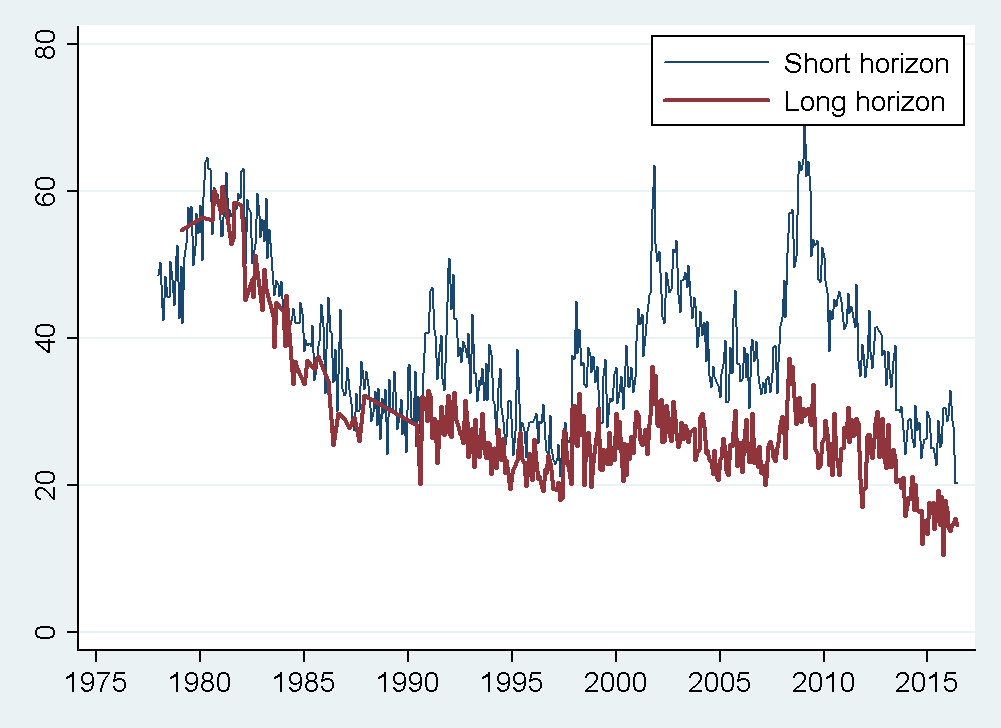
In my working paper "Measuring Uncertainty Based on Rounding: New Method and Application to Inflation Expectations," I develop a new measure of consumers' uncertainty about future inflation. The measure is based on a well-documented tendency of people to use round numbers to convey uncertainty or imprecision across a wide variety of contexts. As I detail in the paper, a strikingly large share of respondents on the Michigan Survey of Consumers report inflation expectations that are a multiple of 5%. I exploits variation over time in the distribution of survey responses (in particular, the amount of "response heaping" around multiples of 5) to create inflation uncertainty indices for the one-year and five-to-ten-year horizons.

As new Michigan Survey data becomes available, I have been updating the indices and posting them here. I previously blogged about the update through November 2015. Now that a few more months of data are publicly available, I have updated the indices through June 2016. Figure 1, below, shows the updated indices. Figure 2 zooms in on more recent years and smooths with a moving average filter. You can see that short-horizon uncertainty has been falling since its historical high point in the Great Recession, and long-horizon uncertainty has been at an historical low.

Figure 1: Consumer inflation uncertainty index developed in Binder (2015) using data from the University of Michigan Survey of Consumers. To download updated data, visit https://sites.google.com/site/inflationuncertainty/. 

Figure 2: Consumer inflation uncertainty index (centered 3-month moving average) developed in Binder (2015) using data from the University of Michigan Survey of Consumers. To download updated data, visit https://sites.google.com/site/inflationuncertainty/. 

The change in response patterns from 2015 to 2016 is quite interesting. Figure 3 shows histograms of the short-horizon inflation expectation responses given in 2015 and in the first half of 2016. The brown bars show the share of respondents in 2015 who gave each response, and the black lines show the share in 2016. For both years, heaping at multiples of 5 is apparent when you observe the spikes at 5 (but not 4 or 6) and at 10 (but not 9 or 11). However, it is less sharp than in other years when the uncertainty index was higher. But also notice that in 2016, the share of 0% and 1% responses rose and the share of 2, 3, 4, 5, and 10% responses fell relative to 2015.

Some respondents take the survey twice with a 6-month gap, so we can see how people switch their responses. Of the respondents who chose a 2% forecast in the second half of 2015 (those who were possible aware of the 2% target), 18% switched to a 0% forecast and 24% switched to a 1% forecast when they took the survey again in 2016. The rise in 1% responses seems most noteworthy to me-- are people finally starting to notice slightly-below-target inflation and incorporate it into their expectations? I think it's too early to say, but worth tracking.

Figure 3: Created by Binder with data from University of Michigan Survey of Consumers


Friday, June 17, 2016

The St. Louis Fed's Regime-Based Approach

St. Louis Federal Reserve President James Bullard today presented “The St. Louis Fed’s New Characterization of the Outlook for the U.S. Economy.” This is a change in how the St. Louis Fed thinks about medium- and longer-term macroeconomic outcomes and makes recommendations for the policy path.
“The hallmark of the new narrative is to think of medium- and longer-term macroeconomic outcomes in terms of regimes. The concept of a single, long-run steady state to which the economy is converging is abandoned, and is replaced by a set of possible regimes that the economy may visit. Regimes are generally viewed as persistent, and optimal monetary policy is viewed as regime dependent. Switches between regimes are viewed as not forecastable.”
Bullard describes three “fundamentals” that characterize which regime the economy is in: productivity growth (high or low), the real return on short-term government debt (high or low), and state of the business cycle (recession or not). We are currently in a low-productivity growth, low rate, no-recession regime. The St. Louis Fed’s forecasts for the next 2.5 years are made with the assumption that we will stay in such a regime over the forecast horizon. They forecast real output growth of 2%, 4.7% unemployment, and 2% trimmed-mean PCE inflation.

As an example of why using this regime-based forecasting approach matters, imagine that the economy is in a low productivity growth regime in which the long-run growth rate is 2%, and that under a high productivity growth regime, the long-run growth rate would be 4%. Suppose you are trying to forecast the growth rate a year from now. One approach would be to come up with an estimate of the probability P that the economy will have switched to the high productivity regime, then estimate a growth rate of G1=(1-P)*2%+P*4%. An alternative is to assume that the economy will stay in its current regime, in which case your estimate is G2=2%<G1, and the chance that the economy switches regime is an “upside risk” to your forecast. This second approach is more like what the St. Louis Fed is doing. Think of it as taking the mode instead of the expected value (mean) of the probability distribution over future growth. They are making their forecasts based on the most likely outcome, not the weighted average of the different outcomes. 

Bullard claims that P is quite small, i.e. regimes are persistent, and that regime changes are unforecastable. He therefore argues that "the best that we can do today is to forecast that the current regime will persist and set policy appropriately for this regime."  The policy takeaway is that “In light of this new approach and the associated forecast, the appropriate regime-dependent policy rate path is 63 basis points over the forecast horizon.”

The approach of forecasting that the current regime will persist and setting policy appropriately for the current regime is an interesting contrast to the "robust control" literature. As Richard Dennis summarizes, "rather than focusing on the 'most likely' outcome or on the average outcome, robust control argues that policymakers should focus on and defend against the worst-case outcome." He adds:
"In an interesting application of robust control methods, Sargent (1999) studies a simple macro-policy model and shows that robustness, in the “robust control” sense, does not necessarily lead to policy attenuation. Instead, the robust policy rule may respond more aggressively to shocks. The intuition for this result is that, by pursuing a more aggressive policy, the central bank can prevent the economy from encountering situations where model misspecification might be especially damaging."
 In Bullard's Figure 1 (below), we see the baseline forecast corresponding to continuation in the no recession, low real rate of return, low productivity growth regime. We also see some of the upside risks to the policy rate path, corresponding to switches to high real rate of return and/or high productivity growth regimes. We also see the arrow pointing to recession, but the four possible outcomes associated with that switch are omitted from the diagram. Bullard writes that "We are currently in a no recession state, but it is possible that we could switch to a recession state. If such a switch occurred, all variables would be affected but most notably, the unemployment rate would rise substantially. Again, the possibility of such a switch does not enter directly into the forecast because we have no reason to forecast a recession given the data available today. The possibility of recession is instead a risk to the forecast."

 In a robust-control inspired approach, the possibility of switching into a recession state (and hitting the zero lower bound again) would get weighted pretty heavily in determination of the policy path, because even if it is unlikely, it would be really bad. What would that look like? This gets a little tricky because the "fundamentals" characterizing these regimes are not all fundamental in the sense of being exogenous to monetary policy. In particular, whether and when the economy enters another recession depends on the path of the policy rate. So too, indirectly, does the real rate of return on short-term government debt, both through liquidity premia and through expected inflation if we get back to the ZLB.

Sunday, April 24, 2016

Presidential Candidates and Fed Accountability

In an interview with Fortune, Donald Trump gave his views on  Federal Reserve Chair Janet Yellen, who will come up for reappointment in 2018. "I don’t want to comment on reappointment, but I would be more inclined to put other people in," he remarked, despite his opinion that Yellen "has done a serviceable job."

A change in the political party in power does not always result in a new Fed chair. Yellen's predecessor, Ben Bernanke, was first appointed by President George W. Bush and later reappointed by President Obama. Obama remarked, upon reappointing Bernanke in 2009, that "Ben approached a financial system on the verge of collapse with calm and wisdom; with bold action and out-of-the-box thinking that has helped put the brakes on our economic freefall."

Time reported in 2009 that "The Fed chairman is often described as the second most powerful U.S. official; the main check on him is the first most powerful official's power not to reappoint him. That power won't be used this year, and it's easy to see why. But someday, a President may have to use it..." I have written before that Fed accountability is a two-way street requiring diligence on the part of both the Fed and Congress. But the President also plays a role in checking the Fed's power. Just how far should a (prospective) President go?

Recently, Narayana Kocherlakota, who was President of the Federal Reserve Bank of Minneapolis from 2009 through 2015, has been urging Presidential candidates to address their views on the Fed. He proposes five questions we should ask the candidates, including whether they would seek a chair that would want to change the Fed's 2% inflation target, whether they would want the next chair to change the Fed's approach to its full employment mandate, whether they would want the chair to agree with using a Taylor-type rule for monetary policy, and whether they would want the chair to take an interventionist approach in a future crisis.

Kocherlakota tweeted, "Good to see Mr. Trump talking about mon. pol. - more Pres. cands need to talk about this issue." This was not Trump's first discussion of the Fed. Trump previously claimed that "Janet Yellen for political reasons is keeping interest rates so low that the next guy or person who takes over as president could have a real problem."

In Trump's Fortune interview, he continued to express some qualms with low interest rates, namely: "the problem with low interest rates is that it’s unfair that people who’ve saved every penny, paid off mortgages, and everything they were supposed to do and they were going to retire with their beautiful nest egg and now they’re getting one-eighth of 1%." However, he also pointed to an upside of low rates, noting that he would like to take advantage of low interest rates to refinance the debt and increase infrastructure and military spending.

Interestingly, neither of Trump's takes on the Fed's interest rate policy are directly related to the Fed's Congressional mandate. He does not evaluate the Fed's success in achieving either price stability or full employment. Rather, he is concerned with the distributional and fiscal implications of low interest rates--areas in which the Fed chair is traditionally reluctant to tread.

The other candidate who has said most about the Fed is Bernie Sanders, who wrote an op-ed about the Fed in the New York Times in December. Sanders' remarks focus mainly on Fed governance and financial regulation, though he also comments on the Fed's interest rate policy:
The recent decision by the Fed to raise interest rates is the latest example of the rigged economic system. Big bankers and their supporters in Congress have been telling us for years that runaway inflation is just around the corner. They have been dead wrong each time. Raising interest rates now is a disaster for small business owners who need loans to hire more workers and Americans who need more jobs and higher wages. As a rule, the Fed should not raise interest rates until unemployment is lower than 4 percent. Raising rates must be done only as a last resort — not to fight phantom inflation.
On Friday, I took my students in my Federal Reserve class at Haverford on a field trip to DC, where we got to meet with Ben Bernanke at the Brookings Institute. I asked Bernanke whether he thought that the presidential candidates should talk about monetary policy and the (re)appointment of the Fed Chair. He agreed with Kocherlakota that candidates should talk about what they would like to see in a Fed Chair, but said that he does not think it's a good idea to politicize individual interest rate decisions, emphasizing that the Fed does not have goal independence, but does have instrument independence. In other words, Congress has given the Fed a monetary policy mandate—full employment and price stability—but does not specify what the Fed needs to do to try to achieve those goals.

Anyone who wants to is welcome to evaluate the Fed on how successfully they are achieving that mandate. Anyone who wants to is also welcome to evaluate the merits of the mandate itself. Different people will come to different evaluations depending on their own beliefs and preferences. But neither of these two evaluations requires an audit of monetary policy by the Government Accountability Office, as both Sanders and Trump have advocated.

Anyone who is dissatisfied with the mandate itself can go through the usual channels of political change in a democracy and pressure Congress to change the mandate. Congress, by design, is susceptible to such pressure: they need votes. Presidential candidates are in a good position to draw public attention to the Fed's mandate and urge change if they believe it is necessary. Sanders, for example, could propose redefining the Fed's full employment mandate to mean unemployment below 4 percent. I'm not quite sure what kind of mandate Trump would support. It is also fair game for any member of the public to evaluate the Fed on how successfully they are achieving their mandate. But Congress does not (or at least, should not) tell the Fed how to set interest rates to achieve its mandate, and Presidential candidates shouldn't either.