Showing posts with label Ben Bernanke. Show all posts

Sunday, April 24, 2016

Presidential Candidates and Fed Accountability

In an interview with Fortune, Donald Trump gave his views on  Federal Reserve Chair Janet Yellen, who will come up for reappointment in 2018. "I don’t want to comment on reappointment, but I would be more inclined to put other people in," he remarked, despite his opinion that Yellen "has done a serviceable job."

A change in the political party in power does not always result in a new Fed chair. Yellen's predecessor, Ben Bernanke, was first appointed by President George W. Bush and later reappointed by President Obama. Obama remarked, upon reappointing Bernanke in 2009, that "Ben approached a financial system on the verge of collapse with calm and wisdom; with bold action and out-of-the-box thinking that has helped put the brakes on our economic freefall."

Time reported in 2009 that "The Fed chairman is often described as the second most powerful U.S. official; the main check on him is the first most powerful official's power not to reappoint him. That power won't be used this year, and it's easy to see why. But someday, a President may have to use it..." I have written before that Fed accountability is a two-way street requiring diligence on the part of both the Fed and Congress. But the President also plays a role in checking the Fed's power. Just how far should a (prospective) President go?

Recently, Narayana Kocherlakota, who was President of the Federal Reserve Bank of Minneapolis from 2009 through 2015, has been urging Presidential candidates to address their views on the Fed. He proposes five questions we should ask the candidates, including whether they would seek a chair that would want to change the Fed's 2% inflation target, whether they would want the next chair to change the Fed's approach to its full employment mandate, whether they would want the chair to agree with using a Taylor-type rule for monetary policy, and whether they would want the chair to take an interventionist approach in a future crisis.

Kocherlakota tweeted, "Good to see Mr. Trump talking about mon. pol. - more Pres. cands need to talk about this issue." This was not Trump's first discussion of the Fed. Trump previously claimed that "Janet Yellen for political reasons is keeping interest rates so low that the next guy or person who takes over as president could have a real problem."

In Trump's Fortune interview, he continued to express some qualms with low interest rates, namely: "the problem with low interest rates is that it’s unfair that people who’ve saved every penny, paid off mortgages, and everything they were supposed to do and they were going to retire with their beautiful nest egg and now they’re getting one-eighth of 1%." However, he also pointed to an upside of low rates, noting that he would like to take advantage of low interest rates to refinance the debt and increase infrastructure and military spending.

Interestingly, neither of Trump's takes on the Fed's interest rate policy are directly related to the Fed's Congressional mandate. He does not evaluate the Fed's success in achieving either price stability or full employment. Rather, he is concerned with the distributional and fiscal implications of low interest rates--areas in which the Fed chair is traditionally reluctant to tread.

The other candidate who has said most about the Fed is Bernie Sanders, who wrote an op-ed about the Fed in the New York Times in December. Sanders' remarks focus mainly on Fed governance and financial regulation, though he also comments on the Fed's interest rate policy:
The recent decision by the Fed to raise interest rates is the latest example of the rigged economic system. Big bankers and their supporters in Congress have been telling us for years that runaway inflation is just around the corner. They have been dead wrong each time. Raising interest rates now is a disaster for small business owners who need loans to hire more workers and Americans who need more jobs and higher wages. As a rule, the Fed should not raise interest rates until unemployment is lower than 4 percent. Raising rates must be done only as a last resort — not to fight phantom inflation.
On Friday, I took my students in my Federal Reserve class at Haverford on a field trip to DC, where we got to meet with Ben Bernanke at the Brookings Institute. I asked Bernanke whether he thought that the presidential candidates should talk about monetary policy and the (re)appointment of the Fed Chair. He agreed with Kocherlakota that candidates should talk about what they would like to see in a Fed Chair, but said that he does not think it's a good idea to politicize individual interest rate decisions, emphasizing that the Fed does not have goal independence, but does have instrument independence. In other words, Congress has given the Fed a monetary policy mandate—full employment and price stability—but does not specify what the Fed needs to do to try to achieve those goals.

Anyone who wants to is welcome to evaluate the Fed on how successfully they are achieving that mandate. Anyone who wants to is also welcome to evaluate the merits of the mandate itself. Different people will come to different evaluations depending on their own beliefs and preferences. But neither of these two evaluations requires an audit of monetary policy by the Government Accountability Office, as both Sanders and Trump have advocated.

Anyone who is dissatisfied with the mandate itself can go through the usual channels of political change in a democracy and pressure Congress to change the mandate. Congress, by design, is susceptible to such pressure: they need votes. Presidential candidates are in a good position to draw public attention to the Fed's mandate and urge change if they believe it is necessary. Sanders, for example, could propose redefining the Fed's full employment mandate to mean unemployment below 4 percent. I'm not quite sure what kind of mandate Trump would support. It is also fair game for any member of the public to evaluate the Fed on how successfully they are achieving their mandate. But Congress does not (or at least, should not) tell the Fed how to set interest rates to achieve its mandate, and Presidential candidates shouldn't either.

Tuesday, October 13, 2015

Desire to Serve, Ability to Perform, and Courage to Act

Ben Bernanke’s new book, “The Courage to Act: A Memoir of a Crisis and its Aftermath,” was released on October 5. When the title of the book was revealed in April, it apparently hit a few nerves. Market Watch reported that “Not everyone has been enamored with either Bernanke or his book-titling skills,” listing representative negative reactions to the title from Twitter.

On October 7, Stephen Colbert began an interview of Bernanke by asking about his choice of title for the book, to which Bernanke responded, “I totally blame my wife, it was entirely her idea.”

I hope to comment more substantively on the book after I get a chance to read it, but for now, I just wanted to point out a fun fact about the title. The phrase “courage to act” is the third of three parts of the U.S. Air Force Fire Protection motto: “the desire to serve, the ability to perform, and the courage to act.”

Bernanke has made an explicit analogy between monetary policymakers in the crisis and fire fighters before. In a speech at Princeton in April 2014, he said, “In the middle of a big fire, you don’t start worrying about the fire laws. You try to get the fire out.” On his blog, Bernanke described a bill proposed by Senators Elizabeth Warren and David Vitter as “roughly equivalent to shutting down the fire department to encourage fire safety.” The appeal of the fire fighter analogy to technocratic policymakers with academic backgrounds must be huge. How many nerds’ dreams can be summed up by the notion of saving people from fire…with your brain!

Do we want our policymakers “playing fire fighter”? Ideally, we would be better off if they were more like Smoky the Bear, preventing rather than responding to emergencies. Anat Admati, among others, makes this point in her piece “Where’s the Courage to Act on Banks?” in which she argues that “banks need much more capital, specifically in the form of equity. In this area, the reforms engendered by the crisis have fallen far short.”

Air Force Fire Protection selected its motto by popular vote in 1980. The nominator of the motto was Sargent William J. Sawyers. A discussion of the new motto in the 1980 Fire Protection Newsletter reveals additional dimensions of the analogy, as well as its limits: 
The motto signifies that the first prerequisite of a fire fighter is "the desire to serve." The fire fighter must understand that he is "serving" the public and there is no compensation which is adequate to reward the fire fighter for what they may ultimately give - their life. The second part of the motto is absolutely necessary if the fire fighter is to do the job and do it safely. "The ability to perform" signifies not only a physical and mental ability but also that knowledge is possessed which enables the fire fighter to accomplish the task. The final segment of the motto indicates that fire fighters must have an underlying "courage to act" even when they know what's at stake. To enter a smoke filled building not knowing what's in it or where the fire is, or whether the building is about to collapse requires "courage." To fight an aircraft fire involving munitions, pressure cylinders, volatile fuels, fuel tanks, and just about anything else imaginable requires "courage."
The tripartite Air Force Fire Protection motto emphasizes intrinsic motivation for public service and personal competence as prerequisites to courage. Indeed, in the Roman Catholic tradition, courage, or fortitude, is a cardinal virtue. But as St. Thomas Aquinas explains, fortitude ranks third among the cardinal virtues, behind prudence and justice. He writes that “prudence, since it is a perfection of reason, has the good essentially: while justice effects this good, since it belongs to justice to establish the order of reason in all human affairs: whereas the other virtues safeguard this good, inasmuch as they moderate the passions, lest they lead man away from reason's good. As to the order of the latter, fortitude holds the first place, because fear of dangers of death has the greatest power to make man recede from the good of reason.”

Courage alone, without prudence and justice, is akin to running into a burning building, literally or metaphorically. It may either be commendable or the height of recklessness. As we evaluate Bernanke’s legacy at the Fed, and the role of the Fed more generally, any appraisal of courage should be preceded by consideration of the prudence and justice of Fed actions.

Other mottos that were nominated for the Air Force Fire Protection motto are also interesting to consider in light of the Fed-as-fire-fighter analogy. Which others could Bernanke have considered as book titles? The proposed mottos include:
  • Let us know to let you know we care. 
  • Wherever flames may rage, we are there. 
  • Duty bound. 
  • To serve and preserve. 
  • To intercede in time of need. 
  • When no one else can do. 
  • Duty bound when the chips are down. 
  • For those special times. 
  • Forever vigilant
  • Honor through compassion and bravery.
  • To care to be there. 
  • Prepared for the challenge. 
  • Readiness is our profession.
  • To protect - to serve
  • Without fear and without reproach.
  • Fire prevention - our job is everyone's business
  • Support your fire fighters, we can't do the job alone.

Thursday, April 16, 2015

On Bernanke and Citadel

Two weeks ago, I told the Washington Examiner that we don't need to worry about Ben Bernanke's blogging turning him into a "shadow chair." I must confess that I was taken aback this morning to learn that Bernanke will also become a senior adviser to Citadel, a large hedge fund. Let me explain how this announcement modifies some, but not all, of what I wrote in my last post about Bernanke's post-chairmanship role.

I wrote, "We want our top thinkers going into public service at the Fed and other government agencies. These top thinkers place a high value on having a public voice, and the blogosphere is increasingly the forum for that." I still agree with this at gut level. I think Bernanke is an intellectual with the public interest at heart and that he really intends the blog as a public service  Now I also know more about the personal financial interests he has at stake, which I will keep in mind when reading his blogging. (Which we really all should do with whatever we are reading.) I think most people are capable of acting against their best financial interests to maintain ideals and standards, but even the most upright are subject to subconscious suasion.

I also wrote that I hoped Bernanke's blog would increase Fed accountability and transparency. Maybe, but only very indirectly. I don't think Bernanke is personally violating any bounds either by blogging or by joining Citadel, but that his joining Citadel is symptomatic of larger boundary violations in the governance structure of the Fed system and its ties to Wall Street. Bernanke told the New York Times that he was "sensitive to the public's anxieties about the 'revolving door' between Wall Street and Washington and chose to go to Citadel, in part, because it 'is not regulated by the Federal Reserve and I won’t be doing lobbying of any sort.' He added that he had been recruited by banks but declined their offers. 'I wanted to avoid the appearance of a conflict of interest,' he said. 'I ruled out any firm that was regulated by the Federal Reserve.'"

I take him at his word while at the same time expecting and hoping that the public's anxieties about the revolving door will not be calmed by Bernanke's choice of which particular Wall Street firm to join. The public doesn't draw a clear line, nor should they, between Wall Street institutions regulated by the Fed and not regulated by the Fed, or between "lobbying of any sort" and "very public figure saying things to policymakers." Maybe he ruled out conflict of interest to some degree, but certainly not appearance of conflict of interest. So if this looks a little unseemly, I hope that is enough to catalyze change in Fed governance. Even if Bernanke's link to Wall Street is not inherently problematic, the overall role of Wall Street insiders in Fed governance is too large.

Saturday, April 4, 2015

Do Not Fear the Shadow Chair

I was recently interviewed for an article in the Washington Examiner, "Bernanke is Back and Blogging." The author, Joseph Lawler, asked what I thought about a former Federal Reserve chair taking becoming an active blogger, and in particular whether I thought there was a risk of Bernanke becoming a "shadow chairman." Lawler also interviewed Peter Conti-Brown, who said that this was "absolutely" a risk.

I don't share the concern. My response to Lawler was too long for him to include in its entirety, so I'll post it here.
I don't think we need to worry about Ben Bernanke becoming a "shadow chairman." The blog is not as unprecedented as it might seem. Alan Greenspan and Paul Volcker both remain active public figures who not only comment on the economy, but also advocate particular policies. Greenspan has published several books since he was chairman, and Volcker has a think tank, the Volcker Alliance. Neither of them has become a shadow chair. We want our top thinkers going into public service at the Fed and other government agencies. These top thinkers place a high value on having a public voice, and the blogosphere is increasingly the forum for that. If serving precludes them from later participating in the public forum, we will have trouble attracting the best people to these roles in the future. 
I think it is good to have a former Fed chair participating in a forum like a blog, which is freely available to the public and fosters debate. It is also a good thing if this blog brings more attention to the Fed and how it pursues its mandate. Since Fed officials are not elected, the Fed needs to be accountable to the public in other ways, and accountability requires that people are aware of the Fed and really thinking about and challenging its actions. In my dissertation I show that this is not currently the case-- people don't understand the Fed enough to be able to hold it accountable. I argue that the Fed needs a strong new media strategy as part of their communication strategy. If former Fed officials make their opinions public, the public will likely put more pressure on current officials to respond and explain their own views and any differences of opinion. This increases accountability. The Fed also claims to place high value on transparency, which is a change from the central banking philosophy several decades ago, so they should be glad that people formerly at the Fed are trying to explain their thinking in a clear way that helps people understand. 
As a blogger myself, I think it will be very fun to have Bernanke in the blogosphere and to follow him on Twitter. He will bring such an interesting perspective about which topics are really important to think more about. The topics that interest him enough to prompt him to blog will certainly be topics of great interest to the rest of us bloggers. It will be fun to think through and react to what he writes.
Wishing you a very happy Easter!

Friday, July 12, 2013

Divided Fed, Broken Models

This week, it has become abundantly clear that the Fed is "deeply divided." In speeches and public communications, FOMC committee members and  Fed Chairman Ben Bernanke have revealed significant differences in their outlooks and intentions for the economy. Tim Duy writes that "The growing division makes it increasingly difficult to think of "the Fed" as a single entity with regards to policy intentions." This is an extremely important point, because most macroeconomic models do consider the Fed as a single entity, and would have different implications if they did not.

Monetary policy is often modeled as a dynamic game in which the two players are the central banker and the public. Typically, the central banker can choose what private information to reveal to the public. Monetary policymakers' preferences and reputational concerns determine their optimal communication strategy in the equilibrium of this dynamic credibility game (see for example Faust and Svensson 2001). Depending on the exact "rules of the game," the optimal strategy turns out to be something less than full information revelation. This game-theoretic political economy paradigm for thinking about monetary policy became hugely influential after seminal papers by Kydland and Prescott in 1977 and Barro in 1986, and has shaped the way economists think about the merits of central bank independence, rules versus discretion, transparency, and explicit inflation targets, with. Insights from this huge literature have been thoroughly integrated into the policymaking sphere.


In reality, of course, in almost every country, monetary policy is not made by a single representative agent, but rather by a committee of very non-representative agents, each with their own, sometimes conflicting, preferences and reputational concerns. With multiple central bankers, monetary policy is a dynamic game between more than two players-- which makes computing optimal strategies dauntingly complex. Strategic behavior between members of the committee will influence each member's communication strategy with the public and with each other. And the public, aware of these strategic interactions, will have quite a complex task computing their best response.

I'm not quite sure where we go from here. One of the most brilliant and famous game theorists, John Nash, proved that non-cooperative games with an arbitrary finite number of players have a Nash equilibrium. But actually finding such an equilibrium is a huge challenge (plus, the non-cooperative assumption is kind of restrictive.) A pair of computer scientists at Berkeley and Stanford note that "even less is known about computing equilibria in multi-player games than in the (still mysterious) special case of two-player games." Even more telling is the title of another paper by Berkeley computer scientists: "Three-Player Games are Hard."

Wednesday, May 1, 2013

Treasury and MBS Markets as QE Continues

Today the Fed announced that "To support a stronger economic recovery and to help ensure that inflation, over time, is at the rate most consistent with its dual mandate, the Committee decided to continue purchasing additional agency mortgage-backed securities at a pace of $40 billion per month and longer-term Treasury securities at a pace of $45 billion per month."

In February, in response to questions by the House Financial Services Committee, Fed Chairman Ben Bernanke said that the asset purchase programs have not disrupted the markets for longer-term Treasuries or for mortgage-backed securities. The New York Fed followed up on this in the latest Survey of Primary Dealers, from March 2013. Primary dealers are trading counterparties of the New York Fed, and play an important role in implementing the asset purchase program. They are obligated to participate in open market operations and to provide the New York Fed's trading desk with market information and analysis. The primary dealers are surveyed each month to help the FOMC evaluate market expectations about the outlook for the economic and financial conditions and monetary policy.

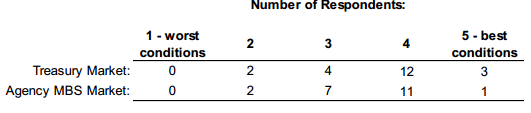
One question from the survey asked: How would you rate market functioning in longer-term Treasury and agency MBS securities markets today relative to the worst and best conditions you have seen since the beginning of 2009? 

Here is a tabulation of the responses:


Most of the dealers agree that conditions in the Treasury market are relatively good. Fifteen out of the 21 dealers rate conditions at 4 or 5 on a five-point scale. In the agency MBS market, conditions are a bit more iffy, though 4 is still the modal response. It looks like most of the dealers agree with Bernanke.

The survey also asked about expectations for the change in the amount of domestic securities held in the System Open Market Account (SOMA) portfolio over the next few years. I plotted the 25th, 50th, and 75th percentiles for expected cumulative changes in treasury holdings and in agency debt and MBS holdings below. Both types of asset holdings are expected to level off in the second half of 2014. But agency debt and MBS holdings are expected to start declining more quickly and rapidly than treasury holdings, which are expected to hold steady through the end of 2015 before beginning to decline.


Respondents were allowed to give written comments on their predictions:
"Some dealers assumed that future declines in the SOMA portfolio would be due to halting reinvestments only, while some dealers assumed halting reinvestments combined with sales. Several dealers expected such declines in the SOMA portfolio to occur at a fixed time before or after the first interest rate increase. Several dealers mentioned their views were based on the June 2011 exit principles while several others mentioned the FOMC will likely review its exit strategy, citing recent communication from Federal Reserve officials...
Some dealers expected sales of agency MBS securities to be a part of the exit strategy from accommodative policy. Some others thought that sales are unlikely or do not expect them to occur, with several mentioning that sufficient tightening could be brought about through other tools, including raising the interest rate paid on excess reserves (IOER) as well as temporary reserve draining."

Expected SOMA holdings at the end of 2014 are contingent on the level of unemployment by the end of this year. The blue bars show the probability distribution over holdings if the unemployment rate is less than 7.4% by the end of 2013. The red bars are if the unemployment rate is between 7.4 and 7.7%, and the green bars are if the unemployment rate is above 7.7%.


Monday, March 4, 2013

Bernanke, Bankers, Bubbles

In 1999, at the height of the dot-com bubble, Ben Bernanke and Mark Gertler argued emphatically against central banks responding to movements in asset prices.  Monetary policy could react to the macroeconomic consequences of asset price movements, but not to asset prices themselves. In other words, monetary policymakers should not raise interest rates solely to address a potential bubble.

After the dot-com bubble burst, they held firm in their opinion in a 2001 paper titled "Should Central Banks Respond to Movements in Asset Prices?" Their answer to the title question is a firm no. They build and simulate a model of the economy that includes both technology shocks and "stock price bubble" shocks and find that "an aggressive inflation-targeting rule stabilizes both output and inflation when asset prices are volatile, whether the volatility is due to bubbles or to technological shocks; and that, given an aggressive response to inflation, there is no significant additional benefit to responding to asset prices."

The housing bubble prompted a number of challenges to the Bernanke-Gertler dictum. A fairly common view is that expansionary monetary policy contributed to the housing bubble. Dean Baker and John Taylor have both argued that the housing bubble was caused by the Fed keeping interest rates too low for too long. (In 2001 the Federal Funds Target rate was lowered from 6.5 to 1.75 percent. In 2003 it was lowered to 1 percent and held there for a year.) Bernanke counters that increased use of variable-rate and interest-only mortgages and the decline of underwriting standards were more to blame than low interest rates.

Now, interest rates are again very low, and have been for quite some time. Challenges to the Bernanke-Gertler view are more vociferous than ever, and come not only from John Taylor but also from Chairman Bernanke's committee members and his contemporaries at other central banks. Fed Governor James Bullard, for example, says that "maybe you should think about using interest rates to fight financial excess a little more than we have in the last few years.” Kansas City Fed President Esther George and Fed Governor Jeremy Stein express similar views that the Fed should use its control of interest rates to do something about "overheating." However, Fed Vice Chairwoman Janet Yellen shares Bernanke's view that the benefits of accomodative monetary policy at this point outweigh the risks of any potential financial overheating.

When Bernanke wrote his 1999 and 2001 papers with Gertler, he was a professor at Princeton University. Another Princeton professor, Lars Svensson, is the Deputy Governor of the Swedish Riksbank. At the Riksbank last month, Governor Stefan Ingves warned that low interest rates are driving up household debt. But Svensson is a strong proponent of his former colleague's views. At the February Rikbank meeting, he argued against the committee's concerns that low interest rates could be leading to financial instability. He cites a 2012 paper by Kenneth Kuttner called "Low Interest Rates and Housing Bubbles: Still no Smoking Gun," whose title summarizes its conclusion.  In particular, Kuttner estimates that a 25 basis point expansionary monetary policy shock raises house prices by about 0.3% to 0.9%, which is "too small to explain the previous decade's real estate boom in the U.S. and elsewhere... Credit conditions, broadly defined, may play a larger role in house price booms than interest rates per se. In market-oriented financial systems, like that of the U.S., a loosening of credit conditions plausibly resulted from financial innovation, such as securitization, and a relaxation of lending standards."

Svensson's long list of publications and speeches reveals a longstanding interest in monetary policy and financial stability, with views consistently in accord with Bernanke's. In a 2011 lecture called "Central-Banking Challenges for the Riksbank: Monetary Policy, Financial-Stability Policy, and Asset Management" Svensson notes:
"Monetary policy and financial-stability policy are distinct policies, with different objectives, different instruments, and different public authorities having responsibility for them... Monetary policy should be conducted taking the conduct of financial-stability policy into account, and vice-versa. But they should not be confused with one another. Confusion risks leading to a poorer outcome for both policies and makes it more difficult to hold the policymakers accountable."
One of the most interesting blog posts I have read on this topic is from Miles Kimball, who writes that people taking on more risk as a result of low interest rates is "a genuine cost to the Fed stimulating the economy with low interest rates. But— especially once we figure out the details—it has much bigger implications for financial regulation than for monetary policy...Regulation has serious costs, but so does tight monetary policy in the current environment." This seems to be the view of Bernanke, Yellen, and Svensson, but is still far from a settled issue among the world's monetary policymakers.