Showing posts with label history. Show all posts

Wednesday, July 6, 2016

Estimation of Historical Inflation Expectations

The final version of my paper "Estimation of Historical Inflation Expectations" is now available online in the journal Explorations in Economic History. (Ungated version here.)
Abstract: Expected inflation is a central variable in economic theory. Economic historians have estimated historical inflation expectations for a variety of purposes, including studies of the Fisher effect, the debt deflation hypothesis, central bank credibility, and expectations formation. I survey the statistical, narrative, and market-based approaches that have been used to estimate inflation expectations in historical eras, including the classical gold standard era, the hyperinflations of the 1920s, and the Great Depression, highlighting key methodological considerations and identifying areas that warrant further research. A meta-analysis of inflation expectations at the onset of the Great Depression reveals that the deflation of the early 1930s was mostly unanticipated, supporting the debt deflation hypothesis, and shows how these results are sensitive to estimation methodology.
This paper is part of a new "Surveys and Speculations" feature in Explorations in Economic History. Recent volumes of the journal open with a Surveys and Speculations article, where "The idea is to combine the style of JEL [Journal of Economic Literature] articles with the more speculative ideas that one might put in a book – producing surveys that can help to guide future research. The emphasis can either be on the survey or the speculation part." Other examples include "What we can learn from the early history of sovereign debt" by David Stasavage, "Urbanization without growth in historical perspective" by Remi Jedwab and Dietrich Vollrath, and "Surnames: A new source for the history of social mobility" by Gregory Clark, Neil Cummins, Yu Hao, and Dan Diaz Vidal. The referee and editorial reports were extremely helpful, so I really recommend this if you're looking for an outlet for a JEL-style paper with economic history relevance.

My paper grew out of a chapter in my dissertation. I was interested in inflation expectations in the Great Depression after serving as a discussant for a paper by Andy Jalil and Gisela Rua on "Inflation Expectations and Recovery from the Depression in 1933:Evidence from the Narrative Record." I also remember being struck by  Christina Romer and David Romer's, (2013, p. 68) remark that a whole “cottage industry” of research in the 1990s was devoted to the question of whether the deflation of 1930-32 was anticipated.
I found it interesting to think about why different papers came to different estimates of inflation expectations in the Great Depression by examining the methodological issues around estimating expectations when direct survey or market measures are not available. I later broadened the paper to consider the range of estimates of inflation expectations in the classical gold standard era and the hyperinflations of the 1920s.

A lot of my research focuses on contemporary inflation expectations, mostly using survey-based measures. Some of the issues that arise in characterizing historical expectations are still relevant even when survey or market-based measures of inflation expectations are readily available--issues of noise, heterogeneity, uncertainty, time-varying risk premia, etc. I hope this piece will also be useful to people interested in current inflation expectations in parts of the world where survey data is unreliable or nonexistent, or where markets in inflation-linked assets are underdeveloped.

What I enjoyed most about writing this paper was trying to determine and formalize the assumptions that various authors used to form their estimates, even when these assumptions weren't laid out explicitly. I also enjoyed conducting my first meta-analysis (thanks to the recommendation of the referee and editor.) I found T. D. Stanley's JEL article on meta-analysis to be a useful guide.


Monday, September 9, 2013

Capital is Back: Wealth Ratios over Several Centuries

This afternoon I attended a seminar called "Capital is Back: Wealth-Income Ratios in Rich Countries 1700-2010" by Thomas Piketty and Gabriel Zucman. From the abstract:
"How do aggregate wealth-to-income ratios evolve in the long run and why? We address this question using 1970-2010 national balance sheets recently compiled in the top eight developed economies. For the U.S., U.K., Germany, and France, we are able to extend our analysis as far back as 1700. We find in every country a gradual rise of wealth-income ratios in recent decades, from about 200-300% in 1970 to 400-600% in 2010. In effect, today’s ratios appear to be returning to the high values observed in Europe in the eighteenth and nineteenth centuries (600-700%). This can be explained by a long run asset price recovery (itself driven by changes in capital policies since the world wars) and by the slowdown of productivity and population growth...Our results have important implications for capital taxation and regulation and shed new light on the changing nature of wealth, the shape of the production function, and the rise of capital shares."
The authors put together a new macro-historical data set on wealth and income, available online, which is "the first international database to include long-run, homogeneous information on national wealth...It can be used to study core macroeconomic questions – such as private capital accumulation, the dynamics of the public debt, and patterns in net foreign asset positions – altogether and over unusually long periods of time."

They suggest that from the interwar period until the 1870s, asset prices were depressed. Then an asset price recovery was driven by changes in capital policies. A U-shaped history of wealth-income ratios is more pronounced for Europe than for the US (Figure 4).

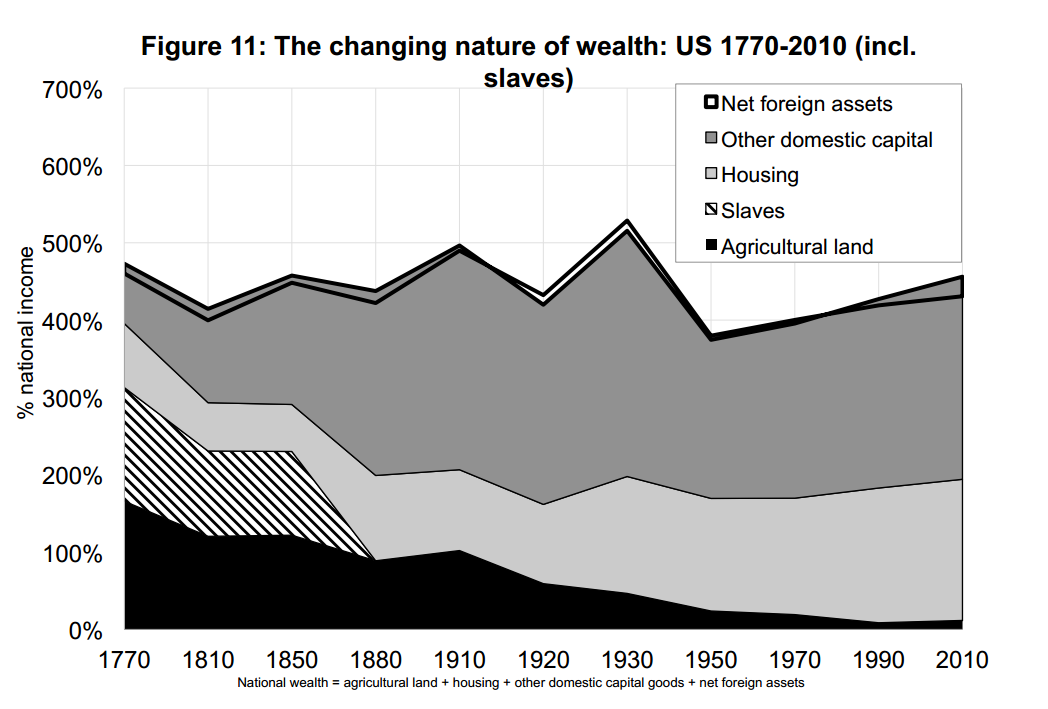
The following two figures show the changing nature of national wealth in the UK (Figure 3) and the US (Figure 10). (The picture for France is quite similar to the UK.) Agricultural land accounted for a staggering 400% of national income in 1870 in the UK, and is basically negligible now. The picture for the US changes if you include slaves as wealth in the antebellum period (Figure 11).

The author also decompose the accumulation of national wealth from 1970-2010 into a saving-induced wealth growth rate and a capital-gains-induced wealth growth rate for eight rich countries (Table 4). Germany is the only country to have experienced a negative capital-gains-induced wealth growth rate.
In Figure 16, below, Piketty and Zucman make a variety of assumptions to compute and simulate the worldwide private wealth to national income ratio from 1870-2100. The ratio bottomed-out in 1950, and they predict that it will continue to rise. This means, they suggest, that wealth inequality is likely to matter more now than in the postwar period, and will continue to matter even more in the future, raising a new set of issues about capital regulation and taxation.


Tuesday, June 25, 2013

Long Before the NSA...

The following clipping is from the April 15, 1813 edition of the Daily National Intelligencer. I came across it by accident, but thought it was worth sharing. In the United States Gazette, the government is accused  of having a "general office for breaking open private letters at Washington."

The Daily National Intelligencer counters that it is "entirely false that any letter of any description has been opened by the government, except letters passing to and from the enemy." The Daily National Intelligencer, if you were wondering, was edited by Joseph Gales, Jr. and William Seaton, supporters of the Madison and Monroe administration. They later became printers of Congress, and Gales became Mayor of Washington, D.C.