Showing posts with label finance. Show all posts

Tuesday, May 2, 2017

Do Socially Responsible Investors Have It All Wrong?

Fossil fuels divestment is a widely debated topic at many college campuses, including my own. The push, often led by students, to divest from fossil fuels companies is an example of the socially responsible investing (SRI) movement. SRI strategies seek to promote goals like environmental stewardship, diversity, and human rights through portfolio management, including the screening of companies involved with objectionable products or behaviors.

It seems intuitive that the endowment of a foundation of educational institution should not invest in a firm whose activities oppose the foundation's mission. Why would a charity that fights lung cancer invest in tobacco, for example? But in a recent Federal Reserve Board working paper, "Divest, Disregard, or Double Down?", Brigitte Roth Tran suggests that intuition may be exactly backwards. She explains that "if firm returns increase with activities the endowment combats, doubling down on the investment increases expected utility by aligning funding availability with need. I call this 'mission hedging.'"

Returning to the example of the lung-cancer-fighting charity, suppose that the charity is heavily invested in tobacco. If the tobacco industry does unexpectedly well, then the charity will get large returns on its investments precisely when its funding needs are greatest (because presumably tobacco use and lung cancer rates will be up).

Roth Tran uses the Capital Asset Pricing Model to show that this mission hedging strategy "increases expected utility when endowment managers boost portfolio weights on firms whose returns correlate with activities the foundation seeks to reduce." More specifically,
"foundations that do not account for covariance between idiosyncratic risk and marginal utility of assets will generally under-invest in high covariance assets. Because objectionable firms are more likely to have such covariance, firewall foundations will underinvest in these firms by disregarding the mission in the investment process. SRI foundations will tend to underinvest in these firms even more by avoiding them altogether."
Roth Tran acknowledges that there are a number of reasons that mission hedging is not the norm. First, the foundation may experience direct negative utility from investing in a firm it considers reprehensible-- or experience a "warm glow" from divesting from such a firm. Second, the foundation may worry that investing in an objectionable firm will hurt its fundraising efforts or reputation (if donors do not understand the benefits of mission hedging). Third, the foundation may believe that divestment will directly lower the levels of the objectionable activity, though this effect is likely to be very small. Roth Tran points out that student leaders of the Harvard fossil fuel divestment campaign acknowledged that the financial impact on fossil fuel companies would be negligible.


Saturday, October 15, 2016

Independence at the CFPB and the Fed

One of my major motivations in starting this blog a few years ago was to have a space to grapple with the topic of central bank independence and accountability. One of the most important things I have learned since then is that independence and accountability are highly multi-dimensional concepts; different institutions can be granted different types of independence, and can fail to be accountable in countless ways. As a corollary, nominal or de jure independence does not guarantee de facto independence. Likewise, an institution may be accountable in name only.

A recent ruling by the U.S. Court of Appeals for the District of Columbia about the independence of the Consumer Financial Protection Bureau (CFPB) highlights the complexity of these issues. The CFPB was created under the Dodd-Frank Act of 2010. On Tuesday, a three-judge panel declared that this agency's particular form of independence is unconstitutional. Most notably, the Director of the CFPB-- currently Richard Cordray-- is removable only by the President, and only for cause.

The petitioner in the case against the CFPB, the mortgage lender PHH Corporation, which was subject to a large fine from the CFPB, argued that the CFPB's structure violates Article II of the Constitution. The Appeals Court's decision provides some historical context:
"To carry out the executive power and be accountable for the exercise of that power, the President must be able to control subordinate officers in executive agencies. In its landmark decision in Myers v. United States, 272 U.S. 52 (1926), authored by Chief Justice and former President Taft, the Supreme Court therefore recognized the President’s Article II authority to supervise, direct, and remove at will subordinate officers in the Executive Branch.

In 1935, however, the Supreme Court carved out an exception to Myers and Article II by permitting Congress to create independent agencies that exercise executive power. See Humphrey’s Executor v. United States, 295 U.S. 602 (1935). An agency is considered “independent” when the agency heads are removable by the President only for cause, not at will, and therefore are not supervised or directed by the President. Examples of independent agencies include well-known bodies such as the Federal Communications Commission, the Securities and Exchange Commission, the Federal Trade Commission, the National Labor Relations Board, and the Federal Energy Regulatory Commission... To help mitigate the risk to individual liberty, the independent agencies, although not checked by the President, have historically been headed by multiple commissioners, directors, or board members who act as checks on one another. Each independent agency has traditionally been established, in the Supreme Court’s words, as a “body of experts appointed by law and informed by experience."
The decision goes on to add that "No head of either an executive agency or an independent agency operates unilaterally without any check on his or her authority. Therefore, no independent agency exercising substantial executive authority has ever been headed by a single person. Until now."

Although the Federal Reserve, unlike the CFPB, has a seven-member Board of Governors, several aspects of their governance are similar: the CFPB Director, like the seven members of the Federal Reserve Board of Governors, is nominated by the President and approved by the Senate. The CFPB Director's term length is 5 years, compared to 14 years for the Governors-- but importantly, both have terms longer than the 4-year Presidential term. The Chair and Vice Chair of the Fed are nominated from the Governors by the President and approved by the Senate for a 4-year term. Both the CFPB Director and the Fed Chair are required to give semi-annual reports to Congress. See these resources for a more detailed comparison of the structure and governance of independent federal agencies.

I find it striking that the phrase individual liberty appears 32 times in the 110-page decision. The very first paragraph states, "This is a case about executive power and individual liberty. The U.S. Government’s executive power to enforce federal law against private citizens – for example, to bring criminal prosecutions and civil enforcement actions – is essential to societal order and progress, but simultaneously a grave threat to individual liberty."

Even though both the CFPB and the Fed have substantial financial regulatory authority, the discourse on Federal Reserve independence does not focus so heavily on liberty (I've barely come across the word at all in my readings on the subject); instead, it focuses on independence as a potential threat to accountability. As I have previously written, "the term accountability has become 'an ever-expanding concept,'" and one that is often not usefully defined. The same might be said for the term liberty. Still, the two terms have different connotations. Accountability requires that the institution carry out its responsibilities satisfactorily, while liberty is more about what the institution doesn't do.

Accountability is a key concept in the literature on delegation of tasks to technocrats or politicians. In "Bureaucrats or Politicians?," Alberto Alesini and Guido Tabellini (2007) build a model in which politicians are held accountable by their desire for re-election, while top-level bureaucrats are held accountable by "career concerns." The social desirability of delegating a task to an unelected bureaucrat depends on how the task affects the distribution of resources or advantages-- and thus, on the strength of interest-group political pressure. As Alan Blinder writes:
"Some public policy decisions have -- or are perceived to have -- mostly general impacts, affecting most citizens in similar ways. Monetary policy, for example...is usually thought of as affecting the whole economy rather than particular groups or industries. Other public policies are more naturally thought of as particularist, conferring benefits and imposing costs on identifiable groups...When the issues are particularist, the visible hand of interest-group politics is likely to be most pernicious -- which would seem to support delegating authority to unelected experts. But these are precisely the issues that require the heaviest doses of value judgments to decide who should win and lose. Such judgments are inherently and appropriately political. It's a genuine dilemma."
The Federal Reserve's Congressional mandate is to promote price stability and maximum employment. Federal Reserve independence is intended to promote these objectives by alleviating political pressure to pursue overly-accomodative monetary policy. Of course, as we have seen in recent years, the interest-group politics of central banking are more nuanced than a simple desire by incumbents for inflation. Interest rate policy and inflation affect different segments of the population in different ways. The CFPB is supposed to enforce federal consumer financial laws and protect consumers in financial markets. The average benefits of the CFPB to individual consumers is probably fairly small, while the costs of regulation and enforcement to a smaller number of financial companies is large. This asymmetry means that political pressure on a financial regulator like the CFPB (or on the Fed, in its regulatory role) is likely to come from the side of the financial institutions. In Blinder's logic, this confers a large value on the delegation of authority to technocrats, while at the same time raising the importance of accountability for political legitimacy.

Tyler Cowen writes, "I say the regulatory state already has too much arbitrary power, and this [District Court ruling] is a (small) move in the right direction." It is not the reduction of the regulatory state's power that will necessarily enhance either accountability or liberty, but the reduction of the arbitrariness of the regulatory power. This can come about through transparency (which the Fed typically cites as key to the maintenance of accountability), making policies and enforcement more predictable and less retroactive and reducing uncertainty. I don't know that the types of governance changes implied by the District Court ruling (if it holds) will substantially affect the CFPB's transparency or make it any less capable of pursuing its goals, as I tend to agree with Senator Elizabeth Warren's interpretation that the ruling will only require “a small technical tweak.”

Wednesday, July 27, 2016

Guest Post by Alex Rodrigue: The Fed and Lehman

The following is a guest contribution by Alex Rodrigue, a math and economics major at Haverford College and my fantastic summer research assistant. This post, like many others I have written, discusses an NBER working paper, this one by Laurence Ball. Some controversy arose out of the media coverage of Roland Fryer's recent NBER working paper on racial differences in police use of force, which I also covered on my blog, since the working paper has not yet undergone peer review. I feel comfortable discussing working papers since I am not a professional journalist and am capable of discussing methodological and other limitations of research. The working paper Alex will discuss was, like the Fryer paper, covered in the New York Times. I don't think there's a clear-cut criteria for whether a newspaper should report on a working paper or no--certainly the criteria should be more stringent for the NYT than for a blog--but in the case of the Ball paper, there is no question that the coverage was merited.

In his recently released NBER working paper, The Fed and Lehman Brothers: Introduction and Summary, Professor Laurence Ball of Johns Hopkins University summarizes his longer work concerning the actions taken by the Federal Reserve when Lehman Brothers’ experienced financial difficulties in 2008. The primary questions Professor Ball seeks to answer are why the Federal Reserve let Lehman Brothers fail, and whether explanations for this decision given by Federal Reserve officials, specifically those provided by Chairman Ben Bernanke, hold up to scrutiny. I was fortunate enough to speak with Professor Ball about this research, along with a number of other Haverford students and economics professors, including the author of this blog, Professor Carola Binder.

Professor Ball’s commitment to unearthing the truth about the Lehman Brothers’ bankruptcy and the Fed’s response is evidenced by the thoroughness of his research, including his analysis of the convoluted balance sheets of Lehman Brothers and his investigation of all statements and testimonies of Fed officials and Lehman Brothers executives. Professor Ball even filed a Freedom of Information Act lawsuit against the Board of Governors of the Federal Reserve in an attempt to acquire all available documents related to his work. Although the suit was unsuccessful, his commitment to exhaustive research allowed for a comprehensive, compelling argument to reject the justification of the Federal Reserve’s in the wake of Lehman Brothers’ financial distress.

Among other investigations into the circumstances of Lehman Brothers’ failure, Ball analyzes the legitimacy of claims that Lehman Brothers lacked sufficient collateral for a legal loan from the Federal Reserve. By studying the balance sheets of Lehman Brothers from the period prior to their bankruptcy, Ball finds “Lehman’s available collateral exceeds its maximum liquidity needs by $115 billion, or about 25%”, meaning that the Fed could have offered the firm a legal, secured loan. This finding directly contradicts Chairman Ben Bernanke’s explanations for the Fed’s decision, calling into question the legitimacy of the Fed’s treatment of the firm.

If the given explanation for the Fed’s refusal to help Lehman Brothers is invalid, then what explanation is correct? Ball suggests Secretary Treasurer Henry Paulson’s involvement in negotiations with the institution at the Federal Reserve Bank of New York, and his hesitance to be known as “Mr. Bailout,” as a possible reason for the Fed’s behavior. Paulson’s involvement in the case seems unusual to Professor Ball, especially because his position as a Secretary Treasurer gave him “no legal authority over the Fed’s lending decisions.” He also cites the failure of Paulson and Fed officials to anticipate the destructive effects of Lehman’s failure as another explanation for the Fed’s actions.

When asked about the future of Lehman Brothers had the Fed offered the loans necessary for its survival, Ball claims that the firm may have survived a bit longer, or at least for long enough to have wound down in a less destructive manner. He believes the Fed’s treatment of Lehman had less to do with the specific financial circumstances of the firm, and more with the timing of the its collapse. In fact, Professor Ball finds that “in lending to Bear Stearns and AIG, the Fed took on more risk than it would have if it rescued Lehman.” Around the time Lehman Brothers reached out for assistance, Paulson had been stung by criticism of the Bear Stearns rescue and the government takeovers of Fannie Mae and Freddie Mac.” If Lehman had failed before Fannie Mae and Freddie Mac or AIG, then maybe the firm would have received the loans it needed to survive.


The failure of Lehman Brothers’ was not without consequence. In discussion, Professor Ball cited a recent NYT article about his work, specifically mentioning his agreement with its assertion that the Fed’s allowance of the failure of the Lehman Brothers worsened the Great Recession, contributed to public disillusionment with the government’s involvement in the financial sector, and potentially led to the rise of “Trumpism” today. 

Monday, March 7, 2016

A Financial-Fiscal Trilemma

Financial crises and sovereign debt crises are, of course, not a new phenomenon. But the strong connection between fiscal crises and financial crises is relatively recent, primarily developing since the Great Depression and especially since the 1980s. In a new and ambitious NBER working paper, Michael Bordo and Chris Meissner survey the literature on financial and fiscal crises and their interconnections, providing both a history of thought and a catalog of open questions.

The key to the growing link between fiscal and financial crises, they explain, is the increased use of government guarantees of financial institutions. This means that banking crises are often followed by a rise in the debt-to-GDP ratio that can be partially attributed to costs of reconstructing the financial sector. Based on a synthesis of the research in this area and some preliminary empirical analysis, Bordo and Meissner posit that countries face a “financial/fiscal trilemma.” As they explain:
This financial/fiscal trilemma suggests 43 that countries have two of the following three choices: a large financial sector, a large bailout package, and a strong discretionary reaction to the downturn associated with financial crises. The logic is as follows by way of an example. Assume a country with a large financial sector faces a banking crisis. If so, then the government can provide a bailout package of a size that is commensurate with the size of the financial sector. If so it uses up its fiscal space. Otherwise it could lower the size of the bailout and devote its fiscal space to discretionary fiscal policy. With a smaller financial sector, and the same amount of fiscal space, since the size of the bailout would by definition be smaller, the size of the rise in debt due to expansionary policy could rise (p. 42-43). 
They use data from Laeven and Valencia (2012) on 19 systematic banking crises to estimate the equation:
Fiscal costs refer to the fiscal costs of bailouts in the three years following a crisis. Discretion is the change in debt not due to the fiscal costs of bailouts, also in the three years following a crisis. The estimation results, with standard errors in parentheses, are:

Notice that the estimated coefficients on the fiscal cost and discretion to GDP ratios sum to approximately 1, suggestive of a tradeoff. If the financial sector is smaller, or if the bailout package is smaller, then the change in fiscal costs to GDP ratio is likely to be smaller, which could allow a larger change in the discretion to GDP ratio, hence the "trilemma." The trilemma is illustrated by Figure 5, below. The discretion to GDP ratio is on the y-axis and the fiscal costs of bailout to GDP ratio is on the x-axis. For a given change in the debt to GDP ratio, the regression estimates imply an "iso-line" showing the fiscal costs of bailouts and discretion to GDP ratios that are possible.

Source: Bordo and Meissner (2015)

As further evidence of the trilemma, they present Figure 6, which illustrates that countries with a larger financial sector, as measured by the domestic credit to GDP ratio, tend to have a larger rise in the share of the debt to GDP ratio explained by bailouts.
Source: Bordo and Meissner (2015)
This evidence of a new "trilemma" certainly merits more rigorous empirical evaluation. As the authors note, however, empirical studies of financial and fiscal crises face the challenge of inconsistent classification and measurement. Alternative crisis chronologies lead to contradictory results. Bordo and Meissner thus propose the following:
If economists and policy makers truly believed that crises were an important phenomenon to understand and possibly avoid then it might be the case that an independent crisis dating committee could help set the standard in much the same way the NBER business cycle dating committee works. The advantage of following this model is that the NBER is a respected non-governmental, non-partisan organization. Other organizations such as the IMF are not sufficiently politically independent. If crises are becoming increasingly global and crisis fighting is a global public good, then the importance of such a reform should be obvious. 

Wednesday, July 8, 2015

Trading on Leaked Macroeconomic Data

The official release times of U.S. macroeconomic data are big deals in financial markets. A new paper finds evidence of substantial informed trading before the official release time of certain macroeconomic variables, suggesting that information is often leaked. Alexander Kurov, Alessio Sancetta, Georg H. Strasser, and Marketa Halova Wolfe examine high-frequency stock index and Treasury futures markets data around releases of U.S. macroeconomic announcements:
These announcements are quintessential updates to public information on the economy and fundamental inputs to asset pricing. More than a half of the cumulative annual equity risk premium is earned on announcement days (Savor & Wilson, 2013) and the information is almost instantaneously reflected in prices once released (Hu, Pan, & Wang, 2013). To ensure fairness, no market participant should have access to this information until the official release time. Yet, in this paper we find strong evidence of informed trading before several key macroeconomic news announcements....Prices start to move about 30 minutes before the official release time and the price move during this pre-announcement window accounts on average for about a half of the total price adjustment.
They consider the 30 macroeconomic announcements that other authors have shown tend to move markets, and find evidence of:

  • Significant pre-announcement price drift for: CB consumer confidence index, existing home sales, GDP preliminary, industrial production, ISM manufacturing index, ISM non-manufacturing index, and pending home sales.
  • Some pre-announcement drift for: advance retail sales, consumer price index, GDP advance, housing starts, and initial jobless claims.
  • No pre-announcement drift for: ADP employment, durable goods orders, new home sales, non-farm employment, producer price index, and UM consumer sentiment.
The figure below shows mean cumulative average returns in the E-mini S&P 500 Futures market from 60 minutes before the release time to 60 minutes after the release time for the series with significant evidence of pre-announcement drift.

Source: Kurov et al. 2015, Figure A1, panel c. Cumulative average returns in the E-mini S&P 500 Futures market .
Why do prices start to move before release time? It could be that some traders are superior forecasters, making better use of publicly-available information, and waiting until a few minutes before the announcement to make their trades. Alternatively, information might be leaked before the official release. Kurov et al. note that, while the first possibility cannot be ruled out entirely, the leaked information explanation appears highly likely. The authors conducted a phone and email survey of the organizations responsible for the macroeconomic data in their study to find out about data release procedures:
The release procedures fall into one of three categories. The first category involves posting the announcement on the organization’s website at the official release time, so that all market participants can access the information at the same time. The second category involves pre-releasing the information to selected journalists in “lock-up rooms” adding a risk of leakage if the lock-up is imperfectly guarded. The third category, previously not documented in academic literature, involves an unusual pre-release procedure used in three announcements: Instead of being pre-released in lock-up rooms, these announcements are electronically transmitted to journalists who are asked not to share the information with others. These three announcements are among the seven announcements with strong drift.
I wish I had a better sense of who was obtaining the leaked information and how much they were making from it.

Thursday, April 16, 2015

On Bernanke and Citadel

Two weeks ago, I told the Washington Examiner that we don't need to worry about Ben Bernanke's blogging turning him into a "shadow chair." I must confess that I was taken aback this morning to learn that Bernanke will also become a senior adviser to Citadel, a large hedge fund. Let me explain how this announcement modifies some, but not all, of what I wrote in my last post about Bernanke's post-chairmanship role.

I wrote, "We want our top thinkers going into public service at the Fed and other government agencies. These top thinkers place a high value on having a public voice, and the blogosphere is increasingly the forum for that." I still agree with this at gut level. I think Bernanke is an intellectual with the public interest at heart and that he really intends the blog as a public service  Now I also know more about the personal financial interests he has at stake, which I will keep in mind when reading his blogging. (Which we really all should do with whatever we are reading.) I think most people are capable of acting against their best financial interests to maintain ideals and standards, but even the most upright are subject to subconscious suasion.

I also wrote that I hoped Bernanke's blog would increase Fed accountability and transparency. Maybe, but only very indirectly. I don't think Bernanke is personally violating any bounds either by blogging or by joining Citadel, but that his joining Citadel is symptomatic of larger boundary violations in the governance structure of the Fed system and its ties to Wall Street. Bernanke told the New York Times that he was "sensitive to the public's anxieties about the 'revolving door' between Wall Street and Washington and chose to go to Citadel, in part, because it 'is not regulated by the Federal Reserve and I won’t be doing lobbying of any sort.' He added that he had been recruited by banks but declined their offers. 'I wanted to avoid the appearance of a conflict of interest,' he said. 'I ruled out any firm that was regulated by the Federal Reserve.'"

I take him at his word while at the same time expecting and hoping that the public's anxieties about the revolving door will not be calmed by Bernanke's choice of which particular Wall Street firm to join. The public doesn't draw a clear line, nor should they, between Wall Street institutions regulated by the Fed and not regulated by the Fed, or between "lobbying of any sort" and "very public figure saying things to policymakers." Maybe he ruled out conflict of interest to some degree, but certainly not appearance of conflict of interest. So if this looks a little unseemly, I hope that is enough to catalyze change in Fed governance. Even if Bernanke's link to Wall Street is not inherently problematic, the overall role of Wall Street insiders in Fed governance is too large.

Wednesday, January 22, 2014

Lance Davis (1928-2014)

Lance Edwin Davis passed away this week. A renowned economic historian with major contributions in financial history and institutional economics, Davis was a professor at Caltech from 1968 to 2005.

Davis is associated with cliometrics, a quantitative and systematic approach to analyzing economic history. The term cliometrics--combining Clio, the muse of history, with metrics from econometrics--was coined in the 1950s by a group of economic historians and mathematical economists at Purdue University. Davis was a key member of this group, along with Jonathan Hughes and Stanley Reiter. This group obtained funds from Purdue to start a new conference series, originally called the Conference on the Application of Economic Theory and Quantitative Methods to the Study of Problems of Economic History, and later called the Cliometric Conference, or just Clio.

The Cliometrics Conferences helped bring about a renewal in the economic history field. The new generation of economic historians in the 1950s and 60s began integrating economic theory and empirical evidence more rigorously and creatively than before. Often, this involved extensive efforts to uncover and tabulate historical data. Davis and Louis Stettler's "The New England Textile Industry, 1825-60: Trends and Fluctuations" (1966) is an example of this type of work.

Davis' efforts to integrate theory and empirical evidence are particularly valuable in the area of financial history. In "The Investment Market, 1870-1914: The Evolution of a National Market" (1965), Davis notes that the classical assumption of perfect capital mobility implies that rates of return on capital should be equal across regions and industries. Interest rate differentials provide information about the barriers to capital mobility. Davis' paper gathers data on interest rate differentials among six regions of the United States from 1870-1914 and analyzes the institutional innovations that reduced barriers to capital mobility over that period.

The cliometric approach also brought about a new way of thinking about economic institutions and institutional change. Neoclassical institutional theory flourished in the 1960s, led by Davis and Douglass North, who developed a model of the logic and incentives that shape the institutional environment. Davis and North's hugely influential book, Institutional Change and American Economic Growth (1971), outlines their model and applies it to American economic history.

In other work, Davis focuses on British financial markets and British imperialism. He and Robert Huttenback wrote the book Mammon and the Pursuit of Empire: The Political Economy of British Imperialism, 1860-1912 (1986). They examine the economics of imperialism, including the returns on investment in empire-building and the social costs of maintaining the empire. The analysis portrays British imperialism as a mechanism to that transferred income from the tax-paying middle class to the elites.

Among Davis' other works are In Pursuit of Leviathan: Technology, Institutions, Productivity, and Profits in American Whaling, 1816-1906 (1997) with Robert Gallman and Karin Gleiter, and Evolving Financial Markets and International Capital Flows: Britain, the Americas, and Australia, 1870–1914 (2001) with Robert Gallman.

An interview with Davis in 1998 is full of interesting stories about his life and work, including his naval service in WWII and the Korean War. The interview tells of his role shaping the Caltech social sciences division. He was there when Caltech admitted its first social sciences PhD student, Barry Weingast, in 1974. There is a strong sense of community among economic historians in California, of which Davis was a central part.

Friday, November 8, 2013

Financial Networks and Contagion

"Financial Networks and Contagion," a recent paper by Matthew Elliott, Benjamin Golub, and Matthew Jackson, uses network theory to study how financial interdependencies among governments, central banks, investment banks, and other institutions can lead to cascading defaults and failures.

Source: Elliott et al. 2013

While the model is quite technical, the main theoretical findings are fairly intuitive. They define two key concepts, integration and diversification. Integration refers to the level of exposure of institutions to each other through cross-holdings. Diversification refers to how spread-out the cross-holdings are; in other words, whether a typical organization is held by many others or just a few. The key finding is that at very low or very high levels of integration and diversification there is lower risk of far-reaching cascades of financial failures. The risk of a far-reaching cascade is highest at intermediate levels of integration and diversification. The authors explain:
"If there is no integration then clearly there cannot be any contagion. As integration increases, the exposure of organizations to each other increases and so contagions become possible. Thus, on a basic level increasing integration leads to increased exposure which tends to increase the probability and extent of contagions. The countervailing effect here is that an organization's dependence on its own primitive assets decreases as it becomes integrated. Thus, although integration can increase the likelihood of a cascade once an initial failure occurs, it can also decrease the likelihood of that first failure... 
With low levels of diversification, organizations can be very sensitive to particular others, but the network of interdependencies is disconnected and overall cascades are limited in extent. As diversification increases, a "sweet spot" is hit where organizations have enough of their cross-holdings concentrated in particular other organizations so that a cascade can occur, and yet the network of cross-holdings is connected enough for the contagion to be far-reaching. Finally, as diversification is further increased, organizations' portfolios are sufficiently diversified so that they become insensitive to any particular organization's failure."
Near the end of the paper, they illustrate the model using cross-holdings of debt among six European countries. The figure above is their representation of financial interdependencies in Europe. They conduct something akin to stress tests, simulating cascades of failures under various scenarios that very roughly approximate conditions in 2008. The simulations find that, following a first failure in Greece, Portugal is fails from contagion. After Portugal fails, Spain fails due to its large exposure to Portugal. The high exposure of France and Germany to Spain causes them to fail next in most simulations. Italy is always last to fail due to its low exposure to others' debt. They emphasize that this is intended only as an illustrative exercise at this stage, but could eventually be refined and incorporated into analysis of failure and contagion risk.

*Edited to fix my mistake pointed out by Phil.

Monday, September 16, 2013

Academic Scribblers and the History of Inflation-Protected Securities

In most financial and economic analysis, U.S. Treasuries play the role of the "risk-free" asset. They are risk-free to an approximation only. In particular, since Treasury bonds are nominal, and future inflation is not known with certainty, they carry some inflation risk. Treasury inflation-protected securities (TIPS), like Treasuries, are backed by the full faith and credit of the US government, but are also linked to the Consumer Price Index, reducing inflation risk.

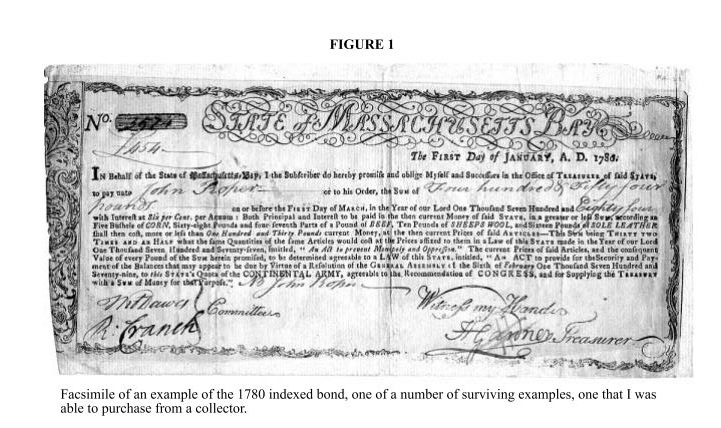
TIPS have a surprisingly interesting history, one that is both longer and shorter than you might expect. Though inflation-indexed bonds made a brief-lived appearance in Massachusetts in 1780, they then disappeared for more than two centuries. TIPS were not issued until 1997, at the urging of then Treasury Secretary Robert Rubin. This is the first of a series of posts I will write about inflation-indexed securities. In this post, I describe their history. In future posts I will review the evidence on whether TIPS have lived up to Rubin's claims that they would benefit savers and reduce the government's borrowing costs, as well as exploring other implications of this teenage asset.

The Commonwealth of Massachusetts created the earliest known inflation-indexed bonds in 1780 in the Revolutionary War. Robert Shiller writes, "These bonds were invented to deal with severe wartime inflation and with angry discontent among soldiers in the U.S. Army with the decline in purchasing power of their pay. Although the bonds were successful, the concept of indexed bonds was abandoned after the immediate extreme inflationary environment passed, and largely forgotten until the twentieth century."
Commonwealth of Massachusetts inflation-indexed bond, 1780, from Shiller (2003).
The 1780 bond reads,
"Both Principal and Interest to be paid in the then current Money of said STATE, in a greater or less SUM, according as Five Bushels of CORN, Sixty-eight Pounds and four-seventh Parts of a Pound of BEEF, Ten Pounds of SHEEPS WOOL, and Sixteen Pounds of SOLE LEATHER shall then cost, more or less than One Hundred and Thirty Pounds current money, at the then current Prices of said ARTICLES—This SUM being THIRTY-TWO TIMES AND AN HALF what the same Quantities of the same Articles would cost at the Prices affixed to them in the Law of this STATE made in the Year of our Lord One Thousand Seven Hundred and Seventy-seven, intitled, 'An Act to prevent Monopoly and Oppression.'"
Thus, the bond functioned similarly to today's TIPS, which are also linked to the price of a market basket of goods (the CPI). Shiller notes that the price index described on the 1780 bond increased 32-fold in three years. The inflation-linked bonds allowed soldiers' pay to keep pace with rising prices. (Curiously, the President of Harvard College, Samuel Langdon, also had his pay linked to this index.) With no explanation, an act in 1786 ended the experiment with indexed bonds.

Shiller explains that this historic episode is a good example of the role of economic theory in financial innovation. "John Maynard Keynes is widely quoted as asserting that most economic innovations derive ultimately from some 'academic scribblers.' But, in fact, in the case of indexed bonds, there was no academic precursor." He adds,
"It seems here that necessity was the mother of this invention. The example of the creation of indexed bonds in Massachusetts in 1780 appears to deny the importance of the “academic scribblers” that Keynes extolled, for the invention appeared long before the scholars wrote about it. And yet, in another sense, it only reinforces their importance, for the practice of indexation of bonds did not take hold at that time. It is a reasonable supposition that the indexed bonds did not continue because there was no well-conceived model that would justify and explain them."
Certain developments in index number theory, for example, did not take place until the twentieth century. A simple price index like the one used on the 1780 bond has what is now a well-known problem. If the price of one of the goods rises, consumers can shift some of their consumption to other goods. Because of the ability to substitute, the increase in the price index is more than the increase in the true cost of living. Irving Fischer proposed a solution in 1922.

It wasn't until later in the twentieth century that inflation-indexed government bonds reappeared. This time around, academic scribblers abounded. The UK was a much earlier adopter than the US. On the recommendation of the Wilson Committee Report of 1980, then Chancellor of the Exchequer Geoffrey Howe announced the Government's intention to issue index-linked gilts.

Other countries, including Canada, Sweden, and New Zealand, followed in subsequent years. Whereas the high inflation in the Revolutionary War prompted inflation-indexed government debt, the high inflation in the US in the late 1970s did not have the same effect, at least not immediately. Shiller became one of the academic scribblers, coauthoring "A Scorecard for Indexed Government Debt" with John Campbell in 1996. Their scorecard came out in favor of creating inflation-indexed government debt. TIPS were introduced in 1997, and have since grown as a share of debt and of GDP (see figure below).
Source: Campbell, Shiller, and Viceira 2009
Campbell and Shiller enumerated multiple potential upsides and downsides to TIPS in their 1996 report. I plan to delve into these in future posts (perhaps at Noahpinion, where I've been guest blogging lately).

(Since I'm writing about finance, I should add the disclaimer that this is not intended to be investment advice.)

Monday, September 9, 2013

Capital is Back: Wealth Ratios over Several Centuries

This afternoon I attended a seminar called "Capital is Back: Wealth-Income Ratios in Rich Countries 1700-2010" by Thomas Piketty and Gabriel Zucman. From the abstract:
"How do aggregate wealth-to-income ratios evolve in the long run and why? We address this question using 1970-2010 national balance sheets recently compiled in the top eight developed economies. For the U.S., U.K., Germany, and France, we are able to extend our analysis as far back as 1700. We find in every country a gradual rise of wealth-income ratios in recent decades, from about 200-300% in 1970 to 400-600% in 2010. In effect, today’s ratios appear to be returning to the high values observed in Europe in the eighteenth and nineteenth centuries (600-700%). This can be explained by a long run asset price recovery (itself driven by changes in capital policies since the world wars) and by the slowdown of productivity and population growth...Our results have important implications for capital taxation and regulation and shed new light on the changing nature of wealth, the shape of the production function, and the rise of capital shares."
The authors put together a new macro-historical data set on wealth and income, available online, which is "the first international database to include long-run, homogeneous information on national wealth...It can be used to study core macroeconomic questions – such as private capital accumulation, the dynamics of the public debt, and patterns in net foreign asset positions – altogether and over unusually long periods of time."

They suggest that from the interwar period until the 1870s, asset prices were depressed. Then an asset price recovery was driven by changes in capital policies. A U-shaped history of wealth-income ratios is more pronounced for Europe than for the US (Figure 4).

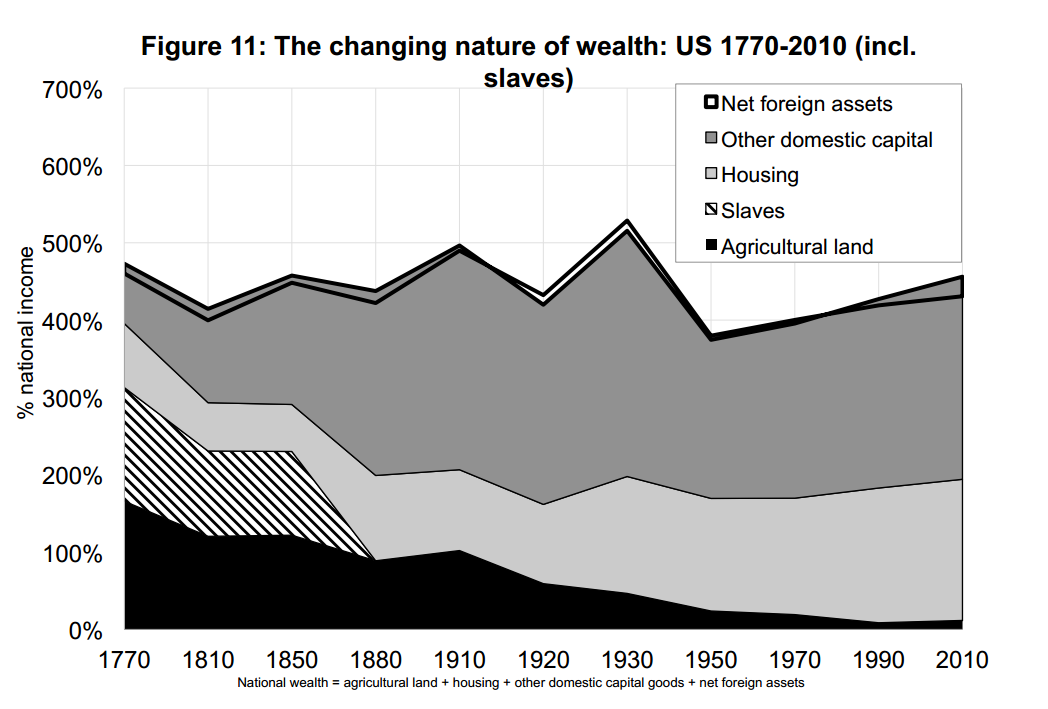
The following two figures show the changing nature of national wealth in the UK (Figure 3) and the US (Figure 10). (The picture for France is quite similar to the UK.) Agricultural land accounted for a staggering 400% of national income in 1870 in the UK, and is basically negligible now. The picture for the US changes if you include slaves as wealth in the antebellum period (Figure 11).

The author also decompose the accumulation of national wealth from 1970-2010 into a saving-induced wealth growth rate and a capital-gains-induced wealth growth rate for eight rich countries (Table 4). Germany is the only country to have experienced a negative capital-gains-induced wealth growth rate.
In Figure 16, below, Piketty and Zucman make a variety of assumptions to compute and simulate the worldwide private wealth to national income ratio from 1870-2100. The ratio bottomed-out in 1950, and they predict that it will continue to rise. This means, they suggest, that wealth inequality is likely to matter more now than in the postwar period, and will continue to matter even more in the future, raising a new set of issues about capital regulation and taxation.


Wednesday, August 7, 2013

Raghuram Rajan is Not Paul Volcker

Raghuram Rajan will take over leadership of the Reserve Bank of India (RBI) on September 4. The BBC lists some of the challenges facing the Indian economy, including a large current account deficit, weak rupee, the slowest growth in a decade (around 5%), and inequality, adding, "Many believe that the single biggest failure of the government's economic policies in recent years has been the inability to control inflation in general and food prices in particular."

It's clear that Rajan will have his work cut out for him, but what kind of work will that be? 

"The monetary situation is such that he may be forced to act as India’s Paul Volcker, hiking up rates and perhaps even orchestrating a recession to get the currency and inflation under control," writes Dylan Matthews. Matthews notes that "By law, India’s central bank doesn’t have much political independence, as Rajan serves at the pleasure of the government and can be sacked at any time. That could deter him from making tough moves against inflation that could have unpopular implications for growth. But Subramanian thinks he’ll have a great deal of flexibility in practice, even if the opposition Bharatiya Janata Party comes to power again."

There is a tendency to want to frame the challenges of the Indian economy in terms of a power struggle between monetary and fiscal authorities-- an "unseemly battle of wits over interest rates," according to Rajrishi Singhal at Bloomberg.  Singhal describes how the Finance Ministry has piled pressure on Rajan's predecessor, RBI Governor Duvvuri Subbarao, to keep rates low. The idea is that, if only the new Governor can stand up to "bullying" and raise rates, then inflation and the rupee can be stabilized. But India in 2013 is not the U.S. in 1979, and Raghuram Rajan need not imitate Paul Volcker.

A central banker's role in India is much different than a central banker's role in the United States or Europe. Monetary policy, remember, is ultimately based on frictions. Prices and inflation are nominal variables. In a frictionless economy, there is no role for monetary policy. It is because of certain frictions that monetary policy can have short-run effects, and these frictions provide the justification for using monetary policy to stabilize economic fluctuations over the business cycle. The optimal monetary policy depends on the nature and magnitude of these frictions. Sticky prices and sticky information are the two categories of frictions most used in the analysis of monetary policy. Both have similar implications for how monetary policy should generally work.

The theory behind the Taylor rule is based on the sticky price friction. The rule recommends a relatively high interest rate or “tight” policy when inflation or employment is relatively high, and a relatively low interest rate in the opposite scenario. According to the Taylor rule, India's policy rates are currently too low. As Ashok Rao writes (in a very excellent post), "A healthy Taylor rule requires an accurate estimate of the output gap which is founded on long-run trend growth. “Trend” growth is a useless concept in countries like India and China, whose growth rates have both a high mean and variance."

But there may be a more fundamental reason why the Taylor rule is not suitable for India. The Taylor rule is based on the sticky price friction, which may not be the dominant friction. Amartya Lahiri suggests that the dominant friction is asset market segmentation (emphasis added).
A well-known feature of the Indian economy is that access to asset markets and instruments is extremely limited. About 140 million households in India do not have access to any formal banking at all. Consequently, less than half of all individuals have access to any formal financial services...It is thus abundantly clear that there is endemic and widespread segmentation in asset markets in India with only a small subset of India having access to formal asset markets. But curiously, discussions about monetary policy in India are completely divorced from this asset market segmentation."
How does asset market segmentation impact the monetary policy calculus? In this case the central bank needs to use monetary policy to provide insurance to those that are absent from these markets. This policy imperative can naturally imply very different monetary policy responses relative to when prices are sticky.
Rajesh Singh, Amartya Lahiri, and Carlos Vegh study optimal monetary policy in environments with segmented asset markets. As Lahiri summarizes,
Intuitively, the role of policy under this friction is to protect households that are excluded from asset markets from excessive fluctuations in their consumption levels. When output is high, consumption of these households tends to rise due to (a) higher income; and (b) higher real money balances as the exchange rate tends to appreciate. By expanding money supply, the central bank can inflate away some of the increase in real balances and thereby moderate the rise in consumption. This procyclicality of the optimal monetary policy is clearly at odds with the Taylor rule prescription that monetary policy should be countercyclical.
The authors also find that asset market segmentation has surprising effects on optimal exchange rate regimes (effectively the opposite of the Mudellian model). They come down in favor of targeting monetary aggregates instead of targeting the exchange rate. The model of Singh et al. is admittedly very stylized and I have found no existing tests of its empirical implications. So I am certainly not actually recommending that Rajan rush to lower interest rates. Nor am I suggesting that Rao's proposal of a rule-based exchange rate policy should be off the table.

Rather, I just intend to highlight the topsy-turvy theoretical results that can arise when we alter the foundations of our models; in particular, when we acknowledge lack of financial inclusion as a significant friction. I also believe that an important role for Rajan, perhaps more important than any decision about interest rates, will be in reforming the financial system and promoting financial inclusion. I am very optimistic on this front. The Financial Times reports that "economists who know Mr Rajan well say helping hundreds of millions of Indians get access to efficient financial services is close to his heart." In 2008, he wrote "A Hundred Small Steps," a report on financial sector reforms. I am most impressed by his inclusion in Chapter 3, "Broadening Access to Finance," of this chart, which shows the interest rates actually paid by people in each income quartile.

It appears that he is quite sensitive to the severity of asset market segmentation in India and to the fact that interest rate movements are not evenly transmitted across all segments of the population.

Thursday, August 1, 2013

Financial Innovation and Speculation

Financial innovation is generally presumed to facilitate diversification and risk sharing. A new paper by Alp Simsek, "Speculation and Risk Sharing with New Financial Assets," suggests that increased speculation may be an additional effect of financial innovation.

The key insight underlying Simsek's theoretical model, and a fact ignored by the traditional literature on financial innovation and portfolio risk, is that market participants are likely to disagree about how to value financial assets. His thesis is that "belief disagreements change the implications of financial innovation for portfolio risks." An existing large literature analyzes the implications of belief disagreements for trading volume and asset prices, but the novelty of Simsek's paper is to analyze the implications of belief disagreements on portfolio riskiness.

In the model, traders take positions in a set of financial assets, allowing them to share and diversify some of their income risks. Suppose traders have heterogeneous beliefs about the payoffs of some asset. The introduction of a new asset leads to riskier portfolios through two channels. First is a direct channel. An investor who is more optimistic than average about the asset’s payoff may take a positive net position in the asset even if her background risk covaries positively with the asset payoff. This is a speculative bet, since it increases the riskiness of her portfolio. Second is a less direct channel called the hedge-more/bet-more effect, through which a new asset amplifies risky bets about existing assets. To illustrate this effect, Simsek gives an example of two currency traders taking positions in the Swiss franc (existing asset) and the euro (new asset):
"Traders have different views about the franc but not the euro, perhaps because they disagree about the prospects of the Swiss economy but not the euro zone. First, suppose traders can only take positions on the franc. In this case, traders do not take too large speculative positions because the franc is affected by several sources of risks, some of which they don’t disagree about. Traders must bear all of these risks, which makes them reluctant to speculate. Next suppose the euro is also introduced for trade. In this case, traders complement their positions in the franc by taking opposite positions in the euro. By doing so, traders hedge the risks that also affect the euro, which enables them to take purer bets on the franc. When traders are able to take purer bets, they also take larger and riskier bets. Consequently, the introduction of the euro in this example increases portfolio risks even though traders do not disagree about its payoff."
A very interesting portion of the paper concerns the endogenous introduction of new assets. New assets do not just exogenously appear in practice. Rather, they are introduced by agents with profit incentives. The literature on endogenous financial innovation tends to emphasize the risk-sharing motive as a driving force. But is the risk-sharing motive for financial innovation still dominant even with belief disagreement? Simsek writes:
"I address this question by introducing a profit-seeking market maker that innovates new assets for which it subsequently serves as the intermediary. The market maker’s expected profits are proportional to traders’ willingness to pay to trade the new assets. Thus, traders’ speculative trading motive and their risk-sharing motive create innovation incentives... When belief disagreements are sufficiently large, the endogenous assets maximize the average variance among all possible choices. Intuitively, the market maker innovates speculative assets that enable traders to bet most precisely on their disagreements, completely disregarding the risk-sharing motive."
Simsek explicitly avoids drawing any policy implications from his results, "because financial innovation might also affect welfare through various other channels not captured in this model." Simsek's paper is motivated by the proliferation of new financial assets in recent years, such as new types of futures, swaps, options, and exotic derivatives. I presume that he has in mind the possibility that the introduction of these assets played a role in the financial crisis, through the theoretical mechanisms detailed in his paper. There are many other historical episodes in which the introduction of a new type of asset was followed by a speculative episode. In the seventeenth century, for example, tulip bulbs took on the role of an asset; intense speculation and an eventual market crash followed. Shares of the South Sea Company were also a new sort of asset upon their introduction in the 18th century, and also prompted speculation.

Friday, July 19, 2013

Let's Not Invent New Ways to Measure Higher Inflation

Matthew Klein of Bloomberg View has just posted an interesting article called "A Better Way to Measure Inflation." He writes:
Sooner or later, most people end up retiring. You may not be working, but you still need money to eat and live. In the U.S., retirees get some income from Social Security, while Medicare covers their healthcare expenses. These programs by themselves aren't enough for most people, which is why it's a good idea to take some of the money you earn during your working life and use it to buy assets that can be consumed later. 
The amount of money you need to spend on assets to guarantee a given standard of living in retirement is determined by your assets' average yield. The higher the yield on your assets, the less money you need to spend today to get an equivalent amount of money in retirement. Falling yields therefore mean you need to spend more money today to guarantee the same amount of money in the future. In other words, the price of retirement, which is a price almost everyone is exposed to, goes up when yields go down.
The Consumer Price Index calculates inflation as the percent change in the price of a "market basket" of goods and services. Klein implies that the Consumer Price Index understates inflation because retirement is left out of the market basket.

"Consumption smoothing" is the usual name for the fact that people want to spread their consumption across their lifetime more smoothly than their income. For example, when people retire and have little or no income, they still want to consume around the same amount as they did before, as Klein describes. So over the lifecycle, a typical person will try to borrow (reduce their net assets) when their income is low and save (increase their net assets) when their income is high. Interest rates, and correspondingly, yields, figure prominently in the analysis of lifetime consumption.

I am a teaching assistant for undergraduate macroeconomics this summer, and we have been teaching the students a variety of different ways to think about interest rates. One way we explain is that interest rates are like a "price" in the market for loanable funds. They are familiar with supply and demand curves from their prerequisite course, so we show them a graph like this:
Klein, I think, is implying that Fed policy has shifted the supply curve to the right, lowering the real interest rate, making the price of loanable funds lower and in turn making the cost of saving for retirement higher. He pays attention to the second part (the higher price of saving), but not the first part (the lower cost of borrowing.) He says that:
People who already own a lot of assets tend to see things differently. For them, falling yields are great because it means that the value of their savings is rising relative to their other expenses. By contrast, workers struggling to save for retirement have to cut back on current purchases of goods and services in order to cover the added cost of their future liabilities. Rising yields have the opposite effect: it makes the asset-rich feel poorer and makes the asset-poor freer to spend more today.
Monetary policy does have different effects on different people, for a variety of reasons, but not really in the way Klein describes. He is considering only people who are currently increasing their net assets. In terms of lifetime consumption models, these are people who are in a part of their lifecycle when their current income is higher than their expected average future income. (These people have earnings above the red line in the figure below.) What he calls the "asset-rich" and the "asset-poor" do not together make up the entire population-- and a lot of "struggling workers" would not accurately fit into his characterization of the "asset-poor."

Especially when unemployment and underemployment are high, a lot of people's current income is lower than their expected average future income. (Somewhere around the blue star in the figure below.) These people are quite rational to want to spend more than their current income. Rising yields would certainly not make them "freer to spend more today." Klein's "asset-poor" leaves out the people with falling (and in many cases also negative) net assets.  In short, Klein argues that our measured inflation leaves out the price of consumption smoothing, but he only considers the saving part of consumption smoothing, and not the borrowing part.
Image Source: Kotlikoff and Burns (not including blue star)

I hope the Fed does not start finding inflation where it doesn't exist as an excuse to raise rates.

Wednesday, July 3, 2013

Stein, Thoma, and Hamilton on Fed Communication

Mark Thoma describes four ways the Fed is creating harmful uncertainty that could block the economic recovery. A June 28 speech by Jeremy Stein, a member of the Board of Governors, describes Stein's opinions on how the Fed should address two out of the four.

Thoma says that the Fed is creating harmful uncertainty through a botched communication policy concerning when quantitative easing will begin tapering off. "The Fed does not seem to understand how anxious it has appeared to return policy to normal over the last several years," he writes. "Any sign of `Green Shoots,' such as the supposed sighting in 2009 by Chairman Bernanke, prompts the Fed to announce that it is developing an exit strategy. With that background, combined with the public perception that the Fed is itching to reverse course and get back to normal, members of the Fed should not be surprised when markets “misread” talk about when the Fed is planning to reverse course. When Fed communication is adding uncertainty instead of reducing it, that’s a big problem."

Another, related way the Fed is creating uncertainty, Thoma notes, is through its consistently overly-optimistic forecasts: "When things turn out much worse than forecast, the Fed has to reverse itself. It has eased policy after these episodes in some cases and that creates quite a bit of uncertainty over Fed policy."

Stein asserts that both the labor market and the general economic outlook have improved since the start of this round of asset purchases nine months ago, but adds that "this very progress has brought communications challenges to the fore, since the further down the road we get, the more information the market demands about the conditions that would lead us to reduce and eventually end our purchases." In other words, "as we get closer to our goals, the balance sheet uncertainty becomes more manageable – at the same time that the
market’s demand for specificity goes up." This seems roughly true, although I would add that it is not balance sheet uncertainty per se that is the most impactful. I think market participants, in contrast to the consensus among Fed officials, generally care more about the flow of asset purchases than the stock on the balance sheet. In other words, while the Fed believes that tapering is not tightening, since it still expands the balance sheet, if at a slower rate, the markets interpret the slower rate as tightening. So the fact that "balance sheet uncertainty" becomes more manageable does not do much to alleviate uncertainty in the financial market.

Stein makes a suggestion that might go some ways towards addressing Thoma's concern about consistently overly-optimistic forecasts:
"A key point is that as we approach an FOMC meeting where an adjustment decision looms, it is appropriate to give relatively heavy weight to the accumulated stock of progress toward our labor market objective and to not be excessively sensitive to the sort of near-term momentum captured by, for example, the last payroll number that comes in just before the meeting...Not only do FOMC actions shape market expectations, but the converse is true as well: Market expectations influence FOMC actions. It is difficult for the Committee to take an action at any meeting that is wholly unanticipated because we don’t want to create undue market volatility. However, when there is a two-way feedback between financial conditions and FOMC actions, an initial perception that noisy recent data play a central role in the policy process can become somewhat self-fulfilling and can itself be the cause of extraneous volatility in asset prices. 
Thus both in an effort to make reliable judgments about the state of the economy, as well as to reduce the possibility of an undesirable feedback loop, the best approach is for the Committee to be clear that in making a decision in, say, September, it will give primary weight to the large stock of news that has accumulated since the inception of the program and will not be unduly influenced by whatever data releases arrive in the few weeks before the meeting – as salient as these releases may appear to be to market participants. I should emphasize that this would not mean abandoning the premise that the program as a whole should be both data-dependent and forward looking. Even if a data release from early September does not exert a strong influence on the decision to make an adjustment at the September meeting, that release will remain relevant for future decisions. If the news is bad, and it is confirmed by further bad news in October and November, this would suggest that the 7 percent unemployment goal is likely to be further away, and the remainder of the program would be extended accordingly."
The question is whether such a commitment would be credible. Market participants might believe that the Fed would treat September near-term news asymmetrically. Participants might (reasonably) believe that a data release from early September may not exert a strong influence on September decisionmaking if it were bad news, whereas if it were good news, the Fed would choose to use it to justify a return to normal.

While Stein recognizes the need to improve the Fed's communication strategy, he also points out that "there are limits to how much even good communication can do to limit market volatility, especially at times like these." In this respect his view is quite similar to that of James Hamilton, who questions the omnipotence sometimes ascribed to the Fed's communication, reminding us that the Fed's communication strategy is not the only determinant of long-term yields.
"Prior to the Great Recession, I thought we had all agreed on the practical limits on the Fed's capabilities. We understood that to some extent the Fed could control the short-term interest rate by changing the supply of reserves available to the banking system. But we also understood that the Fed's influence over longer-term interest rates was much less immediate and direct. The Fed can communicate its long-run inflation objectives, and certainly the 10-year inflation rate is a very important determinant of long-term yields. But regardless of what the Fed may say about its 10-year inflation goals, the market would form its own view of whether the Fed could or would achieve those. Other determinants of long-term yields, such as the term premium, long-run economic growth rate, and global saving and investment decisions were understood to be even farther beyond those things that the Fed can hope to control."
Stein puts it very similarly:
"At best, we can help market participants to understand how we will make decisions about the policy fundamentals that the FOMC controls – the path of future short-term policy rates and the total stock of long-term securities that we ultimately plan to accumulate via our asset purchases. Yet as research has repeatedly demonstrated, these sorts of fundamentals only explain a small part of the variation in the prices of assets such as equities, long-term Treasury securities, and corporate bonds. The bulk of the variation comes from what finance academics call “changes in discount rates,” which is a fancy way of saying the non-fundamental stuff that we don’t understand very well – and which can include changes in either investor sentiment or risk aversion, price movements due to forced selling by either levered investors or convexity hedgers, and a variety of other effects that fall under the broad heading of internal market dynamics...So while we have seen very significant increases in long-term Treasury yields since the FOMC meeting, I think it is a mistake to infer from these movements that there must have been an equivalently big change in monetary policy fundamentals."

Tuesday, May 28, 2013

This Time is Not So Different: The Euro Crisis and the 1840s

In the United States, the 1840s were "an era of fiscal crisis following a decade of fiscal exuberance," according to a paper by Arthur Grinath, JohnWallis, and Richard Sylla. This paper was written in 1997, but its insights into a sovereign debt crisis of long ago provide interesting parallels to today.

In the 1820s and 1830s, state governments made large investments in canals, railroads, and banks. New York and Ohio were the first two states to start canal projects. At first, the expected revenue from the projects was low or uncertain, so New York and Ohio raised taxes to service the canal debt. But the Erie and Ohio canals were highly successful, so subsequent canal construction was financed without corresponding tax increases. New York, Ohio, and other states expected internal improvement projects to produce future revenue, so they didn't feel the need to raise taxes when they began new projects. States were easily able to issue bonds to domestic and foreign (especially British) investors to finance their projects:
“Both state borrowers and lenders, foreign and domestic, anticipated that states could tax land if their bank and transportation projects failed. After 1836, increasing land values and taxable acreage were the common factor underlying state fiscal policies, bank investments, and transportation improvements nationwide. Northeastern states knew they had large amounts of untaxed land, rising in value. It was a fiscal reserve against which they could borrow to finance extensions of their transportation systems. Western states, north and south, were in the midst of the greatest land boom in American history. If northwestern states were uncertain about just when transportation investments would generate revenues, they nonetheless anticipated that many more, and more valuable, acres could soon be taxed. States were thus confident that property tax proceeds would provide adequate fiscal resources to service the debts they incurred. Investors in state bonds concurred.”
State government bonds were considered safe assets because it seemed inconceivable that a state government could default-- their investments were expected to be profitable, and even if they weren't, the states had plenty of potential to increase their tax revenue, especially since land value was rising. Grinath et al. quote Illinois Governor Ford as saying "Mere possibilities appeared to be highly probable, and probabilities wore the livery of certainty itself.”

Gary Gorton, Stefan Lewellen, and Andrew Metrick define a safe asset as one that is information-insensitive. "To the extent that debt is information-insensitive, it can be used efficiently as collateral in financial transactions, a role in finance that is analogous to the role of money in commerce." Gorton elaborates on this idea in an interview with the Region magazine, explaining that debt is "easiest to trade if you’re sure that neither party knows anything about the payoff on the debt." In other words, "The depositors believe that the collateral has the feature that nobody has any private information about it. We can all just believe that it’s all AAA."

In the 1830s, both the states and the investors in state bonds could "believe that it's all AAA" since, even if investment projects turned out not to generate much revenue, states had seemingly boundless untapped tax potential. Thus it was unnecessary for investors in state bonds to find information about the details of states' particular projects. State debt was information-insensitive, a useful property considering how slowly information traveled across the Atlantic in those days.  No need to calculate probabilities when probabilities wear the "livery of certainty itself."

Gorton says that the few really big crisis events in history come from a regime switch in which debt that is information-insensitive becomes information-sensitive. This is precisely what happened in the U.S. states. During the early 1830s expansion and boom of 1835, state debt was information-insensitive, especially as ever-rising land prices promised a large and growing fiscal reserve. But as several domestic and external factors combined to bring about the panic of 1837 and collapse of 1839, the strength of the fiscal reserve was challenged. As land values and property taxes fell, the quality of state's canal, bank, and railroad investment projects suddenly mattered for their ability to service their debt. The situation is described in another paper by Wallis and Namsuk Kim:
In July of 1839, the Morris Canal and Banking Company of New Jersey defaulted on Indiana, and the state quickly was forced to curtail construction on its network of canals and railroads. By the autumn, Illinois and Michigan were forced to slow or stop construction when investment banks defaulted on their obligations to the states. Land sales and land values in these northwestern states had been rising steadily through the 1830s. When transportation construction stopped, land values and property tax revenues began falling and, by late 1839, it was apparent that these states would soon have trouble servicing their debts. In January
of 1841, Indiana was the first state to default on interest payments.
It was a nasty spiral-- as infrastructure projects failed, land values and tax revenue fell further, eroding the states' fiscal positions, making it harder for them to issue bonds and forcing them to pay higher interest rates. This further deteriorated their fiscal positions, and led to suspensions of infrastructure projects and yet higher interest rates. This is similar to what happened in the eurozone, for example in Greece. In the early 2000s, Greece was able to run large deficits without facing high borrowing costs, because the growing economy made Greek sovereign debt information-insensitive. The economic crisis was a "regime change" making sovereign debt information-sensitive. Without the benefit of a fast-growing economy, the Greek government's ability to pay depending much more on its fiscal position, so borrowing rates rose, causing an even worse fiscal position.

The parallels with Greece continue. Many states found, when they tried to raise taxes, that they lacked the state capacity to do so. Property taxes were extremely politically unpopular, and states had trouble not only passing tax legislation but also implementing tax collection. In Maryland, for example, three counties refused to remit their share of the property tax imposed in 1841, and seven refused in 1842. It wasn't until 1845 that the tax was effectively implemented, allowing Maryland to resume debt service. Other states were even less successful in raising property taxes and ended up defaulting and repudiating their debt. Greece also faces a tax evasion problem and encountered serious public and political opposition to attempted austerity measures. In an earlier post I mentioned a paper by Mark Dincecco and Gabriel Katz called "State Capacity and Long Run Performance." State capacity refers a state's ability to tax and to provide public goods and services, called its extractive and productive capabilities, respectively. Dincecco and Katz write:
We argue that the implementation of uniform tax systems at the national level – which we call “fiscal centralization”– enabled European states to effectively fulfill their extractive role. This transformation typically occurred swiftly and permanently from 1789 onward. Similarly, we argue that the establishment of parliaments that could monitor public expenditures at regular intervals – called “limited government” – enabled them to effectively fulfill their productive role. This transformation typically occurred decades after fiscal centralization over the nineteenth century. By the mid-1800s, most European states had achieved “modern” extractive and productive capabilities, implying that they could gather large tax revenues and effectively channel funds toward non-military public services. We argue that these critical improvements in state capacity had strongly positive performance impacts. 
The institutional changes that Dincecco and Katz describe in the late 18th century Europe that brought about extractive capabilities include fiscal centralization and parliamentary, limited government. The U.S. states in the 1840s, and apparently some of the European states today, lack such state capacity, a fact which plays a role in the crises then and now.

Pennsylvania's canals were a financial disaster, so the state faced particularly high borrowing costs, until the Bank of the United States was rechartered as the Bank of the United States Pennsylvania (BUSP). The bank's charter included a promise to underwrite $6 to 8 million in state bond issues. The bank agreed to lend to Pennsylvania at 4%, and as a result, Pennsylvania bond yields in Philadelphia stayed very near to 4% for the next few years. Wallis and Kim write, "Deliberately or not, the BUSP pegged the price of Pennsylvania bonds as a result of its obligations to purchase state bonds over this 18-month period." This is similar to the ECB's Outright Monetary Transactions (OMT) policy, which, by promising to buy sovereign bonds of Eurozone member states, aims to bring down bond yields and lower borrowing costs for countries that face problems selling debt. Though the bank loan program in Pennsylvania was temporarily successful in helping Pennsylvania borrow at lower cost, when the BUSP closed down in 1841, Pennsylvania bond yields jumped immediately, from 6.01% in January 1841 to 9.5% in March.

What ultimately happened in the United States was that the debt crisis forced a change in the structure of public finance. States initiated constitutional restrictions on debt issue and instituted requirements that new spending be matched by new tax increases. The debt crisis in the euro area is also likely to change the structure of public finance, but not in the same way. The United States is both a monetary union and a fiscal union, so even though the states adopted balanced budget amendments, the federal government could still do countercyclical fiscal policy. The euro area is a monetary union without a fiscal union, so it would be very costly for states to institute such restrictions on deficit spending. One possibility is that the euro area will become more of a fiscal and/or banking union; or there may be other changes in the structure of public finance that I can't foresee.